


Fundraising Growth in 2025 Continues to Mask a Shrinking Donor Base


Nonprofits saw their strongest fundraising growth in five years in 2025, but that momentum came with a familiar and deepening tradeoff — fewer total donors.
Total charitable giving increased 5% year over year, while the number of donors declined 3.6%, according to the fourth-quarter report from the Fundraising Effectiveness Project (FEP), a collaboration between the Association of Fundraising Professionals (AFP) Foundation for Philanthropy and GivingTuesday, which tracks year-over-year giving and donor behavior across more than 15,000 nonprofits, representing approximately 7.8 million donors and $13.2 billion in charitable giving.
The widening gap between dollars raised and donor participation signals a structural shift in how fundraising growth is occurring. The data suggests that while organizations are raising revenue, they are doing so from a shrinking and increasingly concentrated donor base.
At a glance, 2025 was a strong year for fundraising. The 5% increase marks the highest growth rate the sector has seen in five years. But that growth was not evenly distributed across donor types.
Instead, major and supersize donors — those giving more than $5,000 annually — drove that growth, increasing both in volume and total dollars. That trend intensified toward the end of the year. Giving was up just 3.7% through the first three quarters before a strong fourth quarter lifted the annual total.
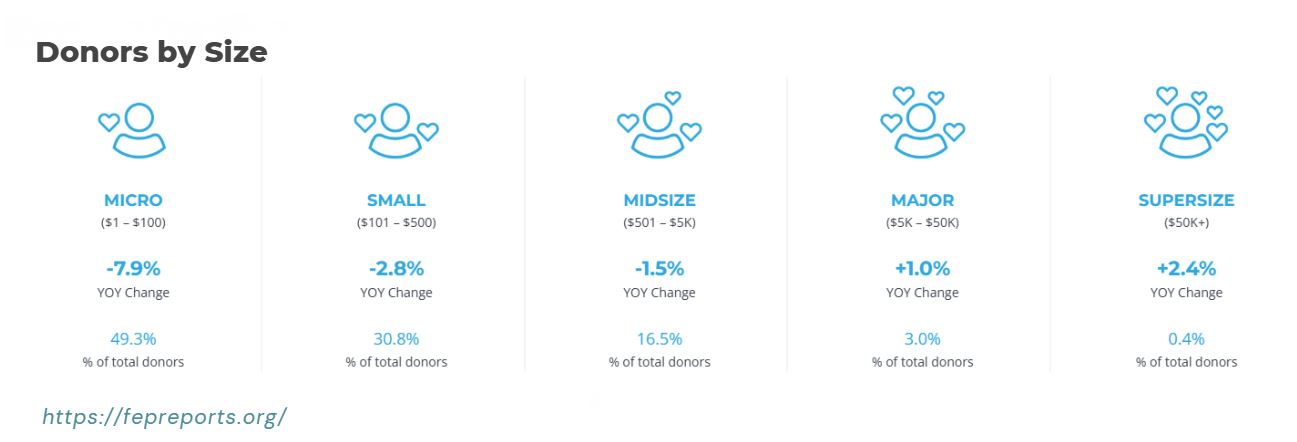
Donors declined across all giving levels in 2025, with the steepest losses among micro and small donors, even as major and supersize donors continued to generate the majority of fundraising revenue. | Credit: Fundraising Effectiveness Project
The pattern reinforces a broader shift: Fundraising gains are increasingly concentrated among a relatively small group of high-value donors. While those gifts can meaningfully boost short-term revenue, they also introduce greater reliance on a narrower segment of supporters.
“The sector’s strongest revenue growth in five years is encouraging, but it should not obscure the fact that we are serving fewer donors for the fifth consecutive year,” Woodrow Rosenbaum, chief data officer of GivingTuesday, said in a statement. “This growth remains concentrated among a shrinking number of large donors, and converting first-time givers into long-term supporters remains the sector’s most pressing challenge.”
The Donor Pipeline Is Breaking at the Base
Beneath the topline growth, the data points to sustained pressure across the donor pipeline — from acquisition to retention.
Micro- and small-dollar donors — those giving $500 or less annually — continue to decline at the fastest rates. These donors still represent a significant share of the donor file, but their numbers are shrinking, and they contribute a relatively small portion of total dollars. The result is a base that is both eroding and less financially influential than higher-tier segments.
At the same time, new donor acquisition remains a critical challenge. The data shows that the number of new donors declined sharply year over year, and first-year retention remained essentially flat.
“Converting a first gift into a second remains the most consequential unsolved problem in the donor pipeline,” researchers wrote.
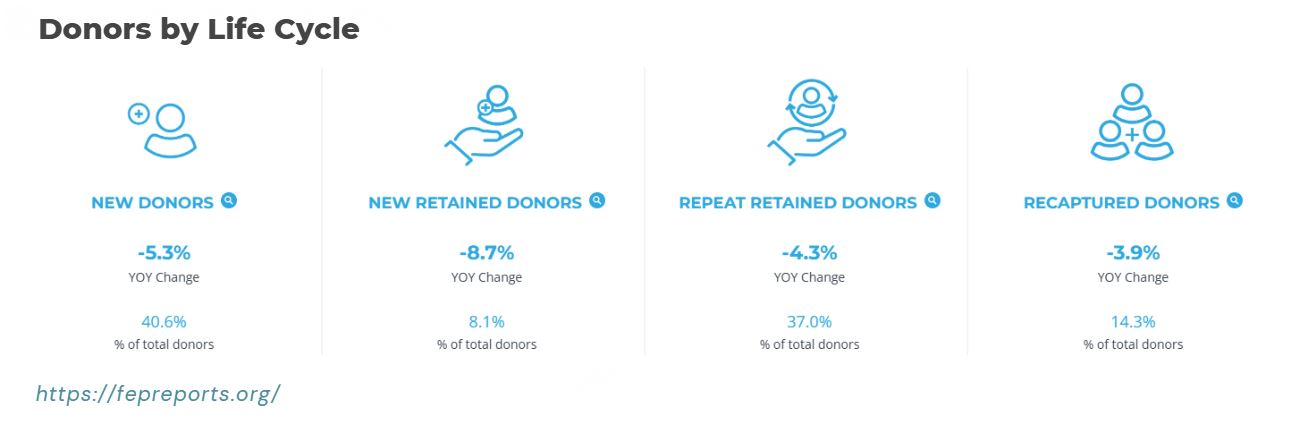
Fundraising Effectiveness Project data shows donor declines across every life cycle segment, with the steepest drops among new and newly retained donors. | Credit: Fundraising Effectiveness Project
That dynamic is compounded by donor behavior patterns. The majority of donors only give once, and that segment is also shrinking. More frequent donors — those who give multiple times in a year — tend to be more stable, but they represent a much smaller portion of the overall base.
These trends reveal the sector is not only losing donors, but that it is struggling to replace them and move new supporters into long-term engagement. Much of that strain is concentrated among new and one-time donors, so making them feel a part of a nonprofit’s mission is more important than ever.
“What this looks like in practice is treating the first month after a donation as the start of a relationship,” researchers wrote. “A timely acknowledgment, followed by a clear sense of what the donation made possible, and then a more personal follow-up helps establish that the donor is part of something ongoing.”
Stability Signals Are Limited
Among existing donors, there are modest signs of stabilization, but they remain limited.
“The rate of decline has been slowing since 2022,” researchers wrote. “This is not a recovery, but it may be an inflection, and it is the most important trend to watch in 2026. Whether that deceleration reflects structural improvement or simply a smaller pool to lose from is a question the next several quarters will begin to answer.”
Overall donor retention increased slightly, from 43.1% to 43.3%. Because retention measures the share of donors who give again — not the total number of donors — it can remain stable even as the overall donor pool shrinks. In short, the stability reflects existing supporter loyalty, but does not necessarily offset continued losses elsewhere in the pipeline.
For fundraisers, the data underscores a tension that has been building for several years — organizations may continue to meet short-term revenue goals, but, in doing so, they are increasingly dependent on a smaller group of donors.
Reversing that trend will likely require renewed focus on the early stages of the donor life cycle — particularly first-time donor conversion — as well as strategies that encourage more consistent, ongoing engagement.
“2025 was a year of uncertainty for many nonprofits, so it’s understandable to want to lean into what’s working, particularly the growth we’ve seen at the highest giving levels,” Ann Hale, CFRE, executive vice president of the AFP Foundations for Philanthropy, said in a statement. “But long-term sustainability depends on a broader base of support. This report highlights the need for fundraisers to diversify their strategies, investing intentionally in engaging and retaining both mid-level and small donors at scale through new technology, accessible ways to give, tax incentives like the universal charitable deduction, and other approaches designed to reach everyday donors.”
- Categories:
- Giving Pyramid
- Individual Giving
- Retention
- Companies:
- Association of Fundraising Professionals
- People:
- Ann Hale
- Woodrow Rosenbaum


