


Nonprofit Sustainability: How Organizations Are Reducing Their Environmental Impact


As a rule, nonprofits are all about making a positive impact on the world. Regardless of mission, one way nonprofits can do this is by bringing sustainable practices into their day-to-day operations.
In fact, 42% of nonprofits said funders and donors were seeking more information on their environmental impact and reduction strategies, per BDO’s 2023 “Nonprofit Standards Benchmarking Survey.”
We spoke with nonprofits to find out how they weave sustainability into operations.
Building Sustainability Into Operations
Sustainability, for many people, evokes thoughts of the environment. But nonprofit sustainability also has an organizational connotation. Mike Hiller, executive director at UpstreamPgh, a Pittsburgh-based urban watershed restoration nonprofit, said that the organization approaches everything from a longevity standpoint.
“I think No. 1 is just making sure the organization can sustain itself from finances and from a resource perspective,” Hiller said. “We've done a lot of work over the last few years to make sure that our finances are sustainable, that they're diverse, that we have a good array of funding sources.”
Hiller said that array currently includes government and private foundation funding as its largest sources of revenue.

UpstreamPgh uses rain barrels to help conserve its water usage. | Credit: UpstreamPgh
Beyond organizational longevity, UpstreamPgh also integrates environmentally conscious practices into daily work. Its environmental mission means that it looks for the most eco-friendly ways to do its work.
“The work that we do is so intertwined with how we operate, so the general mission of connecting people to nature, that sort of permeates throughout the office and the way that we operate,” Hiller said.
These are some of the eco-conscious practices UpstreamPgh has in place:
- Using a hybrid truck.
- Selling and using rain barrels made from recycled plastic.
- Composting.
- Opting for green, nature-based infrastructure solutions to reduce reliance on concrete or plastic storm and sewer pipes.
UpstreamPgh’s office is also a bikeable distance from employees’ homes and is located near transit stations. Similarly, Kristi Koon, vice president of marketing at the ALS Association, said her organization works mostly remotely; since people are spread out across the country, meetings requiring an in-person presence have become less and less prevalent. This has cut down on travel-related environmental impacts.
Hiller added that UpstreamPgh’s building has plenty of natural light thanks to its large windows, which also help with ventilation and temperature control. Additionally, the nonprofit tries to source things locally when possible to mitigate the impact of shipping.
Cutting Paper Waste
Hiller shared that UpstreamPgh has taken a look at its paper-based communications.
“Historically, the organization would send out — twice a year — a print publication that was not on recycled paper,” he said. “And so that would be like a 10-page newsletter that would go out to hundreds, if not even thousands, of people. We do not do that anymore. We now only produce one newsletter a year, and it goes out to a very select group of people. It's just a few hundred people — some of our more major donors.”
The main way the nonprofit shares news now is through a monthly e-newsletter, as well as social media and other email communications.
Hiller noted that they will occasionally mail out donation requests, though those are targeted based on donor data. And, for all its paper communications, the nonprofit will opt for the most sustainable option, as long as it doesn’t compromise quality.
The ALS Association also tries to reduce or eliminate traditionally mailed content — like printed publications and its annual report — by moving to digital versions when possible.
“We’ve really found that, even skewing older, some of our readership, they're going online anyway, and so we've done whatever we can there,” Koon said. “And so that's been a really nice balance between sustainability and cost efficiency for us because it's much easier for us to do that.”
Reducing Waste at Nonprofit Events
UpstreamPgh has taken a similarly minimalistic approach to the materials it uses for events.
“We're not in the business of making a sign and throwing it away,” Hiller said. “We're very intentional — admittedly, most likely, probably from a financial perspective initially. That just doesn't make sense for us. But we are always cognizant of generating waste. … If we can reuse a board to put a sign on it, we're definitely going to be doing stuff like that.”
The ALS Association also tries to minimize how much signage it creates for events, such as its annual ALS Nexus conference. Since it’s held annually, Koon said that the organization tries to reuse signs whenever possible.
“And then the things that we had to redesign, we were doing on tension fabric and being really thoughtful of what's going to transport well, what's going to transport cheaply, what can we reuse over and over again,” Koon said.
Balancing Donor Premiums and Sustainability
Nonprofits often deliberate whether to offer premiums, with concerns revolving around the effectiveness of these items to bring in impactful supporters and the costs associated with them. But another aspect of the age-old debate is the environmental impact.
At the ALS Association, Koon said that most of the campaigns are not premium-based to begin with. However, she said, the organization is assessing whether it could help with certain campaigns.
“We don't want them to just be the ‘nothing’ thing that you throw away,” she said. “We really want it to be something that is meaningful and something that shows our appreciation for valuable donors.”
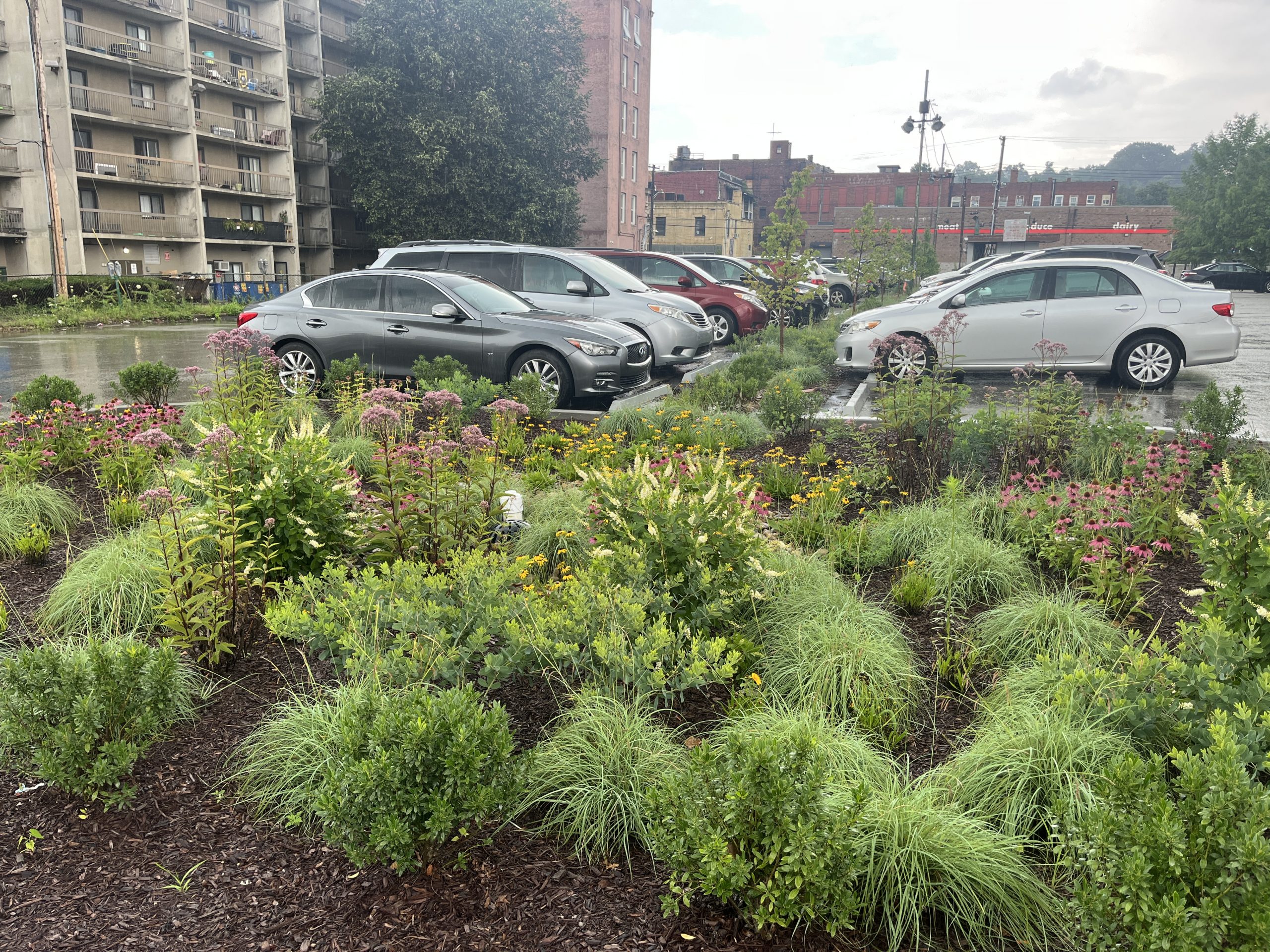
The Wilkinsburg Stormwater Resiliency Project is among UpstreamPgh's efforts to address stormwater. | Credit: UpstreamPgh
Practical Nonprofit Sustainability Tips
Want to improve your nonprofit’s sustainability? Hiller explained that developing policies is a good place to start, especially if your mission doesn’t fall into the environment or nature bucket.
And while Koon acknowledged that making changes to your operations can be daunting, she said that because nonprofits are resilient by nature, they often take changes in stride.
“What I've seen from scaling back on some of the printed stuff is it just really wasn't the horror story that everybody thought it was going to be,” she said. “People thought that when we moved something to digital only, that it was going to be the end-all be-all — ‘I can't believe we're not doing that anymore’ — and it just wasn't. There wasn't this ripple.”
- Categories:
- Direct Mail
- Events
- Strategic Planning
- People:
- Kristi Koon
- Mike Hiller
Kalie VanDewater is senior content editor at NAPCO Media.


