


M+R Benchmarks 2026: What Online Giving Growth Means for Your Donor File


Last year did not feel easy for most fundraisers. Budgets were tight, federal funding was in flux, and it often seemed like every channel needed more attention than your team could reasonably give at once.
All of those efforts seemingly paid off. The 2026 M+R “Benchmarks” study, an annual digital fundraising and marketing study based on data from 180 nonprofits, found online revenue for the average nonprofit rose 15% in 2025, with gains across organization sizes and double-digit increases in nearly every sector.
One-time revenue rose 17%, monthly revenue increased 12%, donor-advised fund revenue jumped 44%, email revenue climbed 16%, mobile revenue surged 48%, and direct mail revenue was up 9%. December alone accounted for 37% of annual online revenue.
At first glance, those figures seem promising, but they may not be built to last.
“To be clear, that's not normal,” Theresa Bugeaud, director of data analytics at M+R, said during a webinar announcing the report. “In most years, we see a mixed bag of small gains or slight declines, but double digit increases across nearly every sector show a major shift in donor response.”
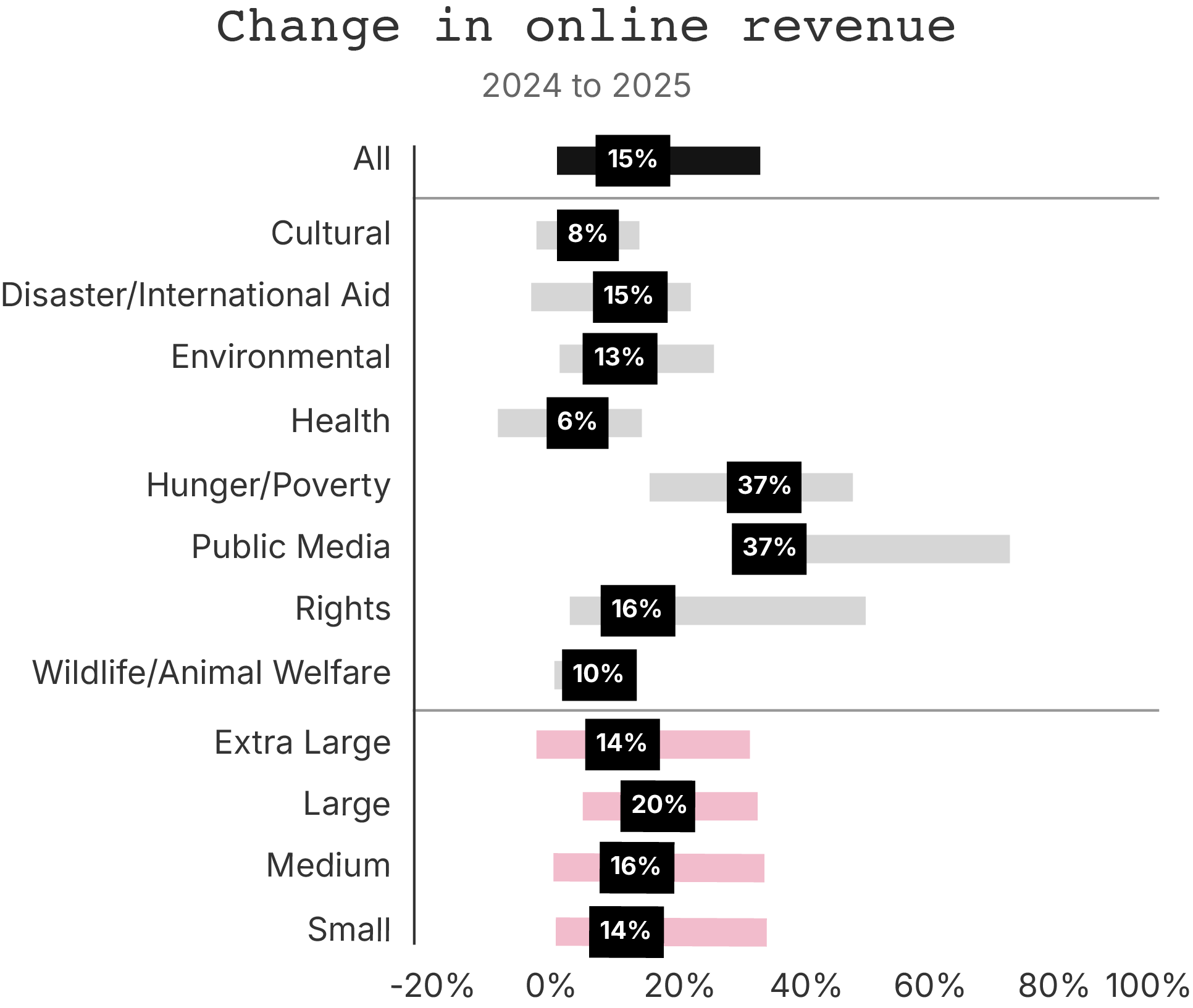
M+R's “Benchmarks” reports that online revenue grew 15% on average in 2025, with public media and hunger and poverty nonprofits each seeing about a 37% increase and several sectors posting double-digit gains. | Credit: M+R “Benchmarks” 2026
The strongest gains were driven by urgency, instability, and in many cases, donor response to threats facing causes and institutions they cared about. Public media and hunger and poverty organizations each saw online revenue increase 37% on average, while M+R researchers tied much of that surge to federal funding cuts and broader crisis conditions.
That makes this year’s data useful not just as a snapshot of growth, but as a planning guide. For fundraisers, the bigger takeaway may be less about how much revenue came in and more about what that growth did to the donor file, how durable it is, and where organizations should focus next.
A Bigger Donor File Doesn’t Necessarily Mean a More Stable One
One of the clearest cautions in the Benchmarks data is that a meaningful share of 2025 online revenue came from donors who may be hard to keep — one-time donors.
In last year’s “Benchmarks,” monthly giving played a larger role in driving growth — a pattern that suggested increasing stability. This year’s data points in a different direction.
Average online revenue from one-time gifts increased 17% in 2025, compared with 12% growth for monthly revenue. However, monthly giving still made up a significant share of online revenue overall (27%) — but the mix varied sharply, ranging from 22% for small nonprofits (revenues less than $1 million) to 37% for extra-large organizations (revenues more than $10 million).
“While the one time surge is great for immediate needs, emergency donors are often very hard to retain — much harder to retain than sustainers,” Bugeaud said.
The study found that new online donors — those who made an online gift in 2025 but not in any of the previous three years — accounted for 31% of online revenue in 2025. Their retention rate was 24%. By contrast, prior online donors — supporters who gave in 2024 and at least once in the previous five years — retained at a 66% rate. Overall, one-time online donor retention was 48%.
That matters because it reframes what many organizations may be looking at internally. A bigger year does not automatically mean a stronger file. In many cases, 2025 appears to have been a major acquisition and reactivation year, with nonprofits bringing in donors during a period of heightened urgency. The opportunity now is to determine how many of those donors can be moved into longer-term relationships.
Monthly giving data underscores that point. After 12 months, 71% of sustainers were still active, while 54% of monthly gifts remained active after two years.
DAFs Are Becoming Core Revenue and December Still Carries Its Weight
The scale of donor-advised funds (DAFs) growth makes them hard to treat as a bonus channel anymore.
Revenue from donor-advised funds increased 44% overall in 2025, while the number of DAF gifts rose 23%. The average donor-advised fund gift remained steady at $1,430, but still far above most other giving channels tracked in the study. The shift was not just about existing DAF donors giving more, but that more donors are using DAFs, Bugeaud said.
“DAF donors are engaged,” she said. “They're much higher average gifts than for other types of giving. And these donors are reacting to the current climate, and they're making gifts.”
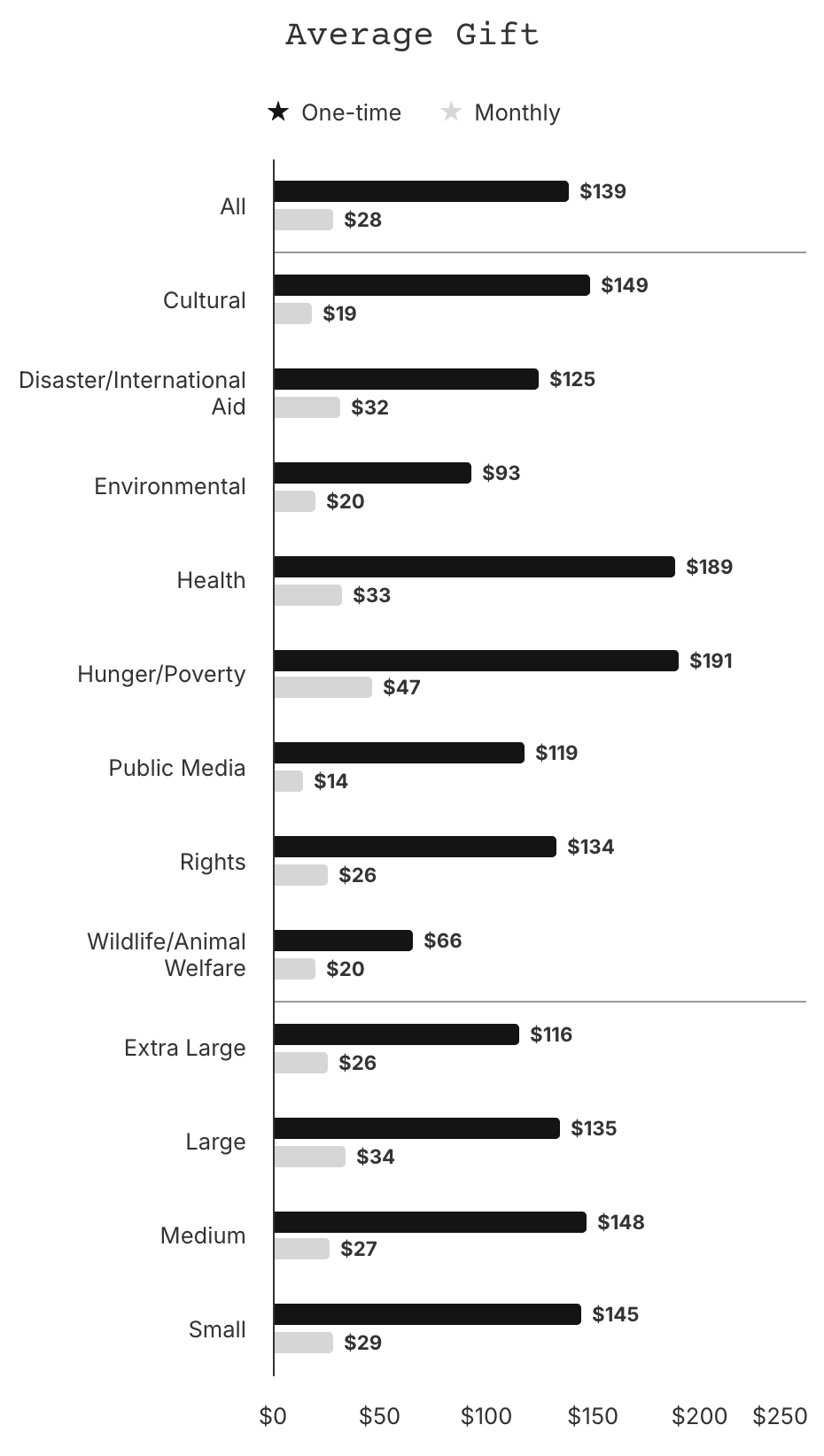
Donor-advised funds stand out for exceptionally large gifts, with an average DAF donation around $1,430 in 2025 and higher averages for sectors like hunger and poverty, according to M+R's “Benchmarks.” | Credit: M+R “Benchmarks” 2026
Meanwhile, nonprofits received 37% of annual online revenue in December. The last week of the year accounted for 10%, and Dec. 31 alone accounted for 4%.
Some of that concentration was calendar-driven. GivingTuesday fell in December in 2025, rather than November, which inflated the month’s share. But not all of it can be explained that way. Hunger and poverty organizations raised 46% of their online revenue in December, and, as supporters responded to funding threats, public media nonprofits saw December revenue rise 32% year over year — well above the 11% average growth across mission types.
Where 2025 Growth Actually Came From
The channel-level data showed that 2025 growth was broadly distributed, but not evenly.
Email remained one of the clearest workhorse channels. Email revenue increased 16%, email list size rose 5%, and nonprofits raised an average of $2.40 per subscriber, up from $1.87 the year before. Nonprofits sent an average of 50 email messages per subscriber over the course of the year, including 31 fundraising appeals.
“A common thread to the history of our ‘Benchmarks’ reports is that most years we find that groups are sending more email and that individual emails are performing a little bit worse,” Jonathan Benton, senior vice president at M+R said during the webinar. “That wasn't the case this year, groups sent more emails, but the performance really held steady, or even went up slightly.”
Mobile
Mobile messaging was much smaller in scale, but one of the fastest-growing channels. Revenue sourced to mobile still accounted for less than 1% of online revenue, yet mobile revenue increased 48% in 2025. Nonprofits had 176 mobile subscribers for every 1,000 email subscribers, a sign that the list-building gap remains substantial.
“The way that people continue to use their mobile devices and the way that nonprofits use mobile messaging is evolving quite swiftly and unpredictably,” Ragini Kathail, senior account supervisor at M+R said during the webinar. “For some that has made steady, reliable growth a challenge, but other organizations are taking big swings, and that means big opportunities for them. So even if you have to start small, this is a place to think about.”
Advertising
Advertising also expanded. Nonprofit digital ad spend rose 18% in 2025, and organizations reinvested $0.10 in ads for every dollar of online revenue.
“This is not a measure of returns,” Sarah Coughlon, director of advertising technology at M+R said during the webinar. “I know it can feel like it. I want you to think about it more as a measure of how much organizations are reinvesting in a channel that has the potential to drive so much future growth. So honestly, I might think about it in terms of how much of your salary are you socking away in your 401(k).”
Website
Then there is the website, where one of the most consequential findings may be less about conversion and more about discovery. Organic search traffic declined over the course of 2025, with M+R linking that drop to AI overviews, zero-click search behavior and the rise of chatbot-based discovery. The share of nonprofit website traffic coming from organic sources fell month by month, even as organic search still accounted for 39% of visits overall.
“Given how important website giving and engagement is for almost every organization, we think the rise of AI search poses a real threat — not just to paid advertising, but also organic website giving,” Diego Ruiz, managing account supervisor and website optimization and testing lead at M+R said during the webinar.
That makes website performance even more important. The study found 1.6% of website visitors made a donation, generating $1.33 per visitor overall. Desktop visitors remained more valuable than mobile visitors: They made up 48% of traffic, but 72% of revenue, with an average gift of $168 compared with $88 on mobile.
“Despite traffic being split roughly half and half, desktop visitors are both more likely to give and more likely to make larger gifts,” he said. “If you're thinking about how this applies to your website, keep in mind, mobile visitors are more likely to be on your website seeking information, while desktop users are more likely to actually make a gift — and a big one.”
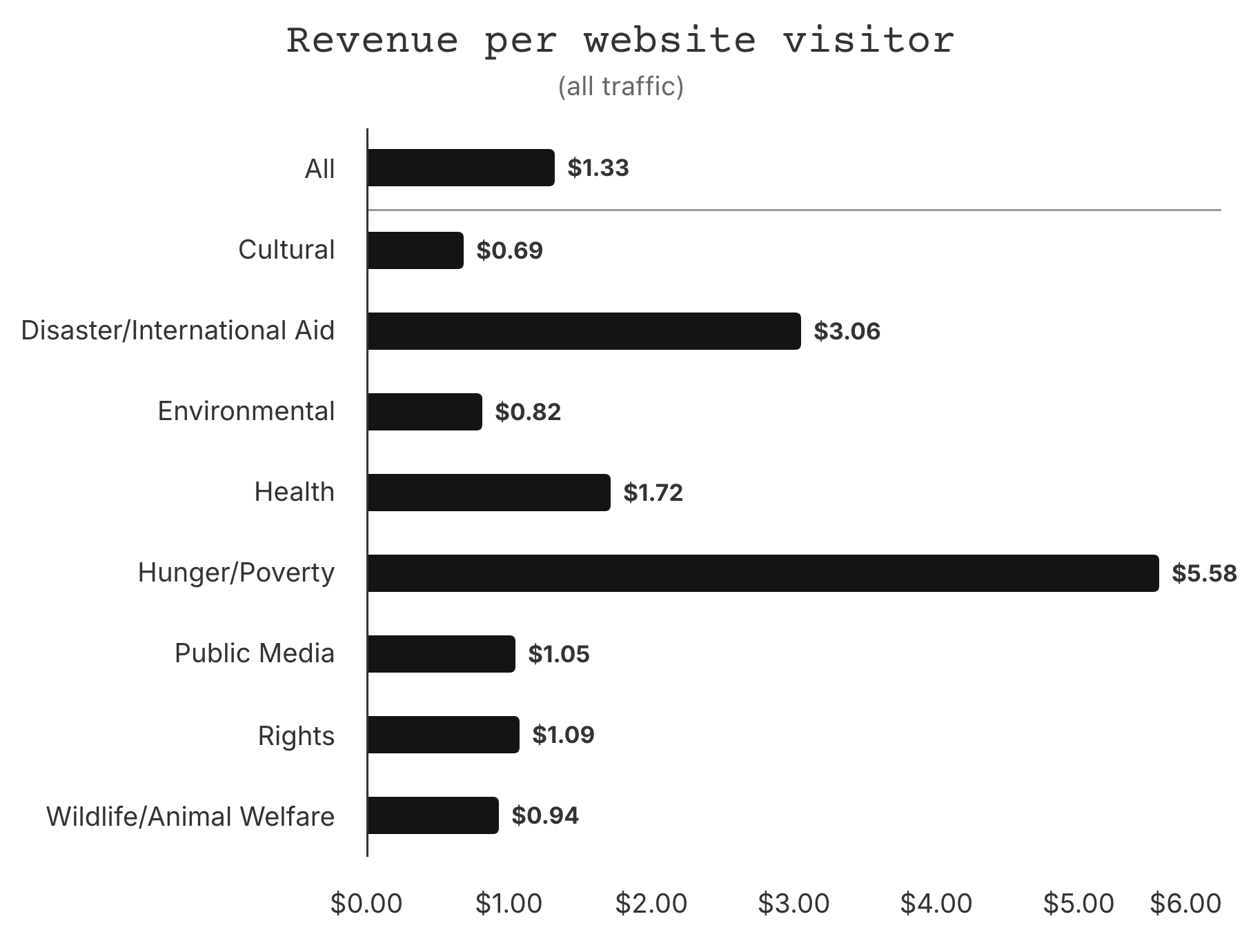
M+R's “Benchmarks” finds that nonprofits received donations from 1.6% of website visitors in 2025, yielding about $1.33 in revenue per visitor overall and significantly higher revenue per visitor for sectors such as hunger and poverty. | Credit: M+R “Benchmarks” 2026
Social
On social, most nonprofits are now active on Facebook, Instagram, LinkedIn, and YouTube — even though roughly a quarter still are not using YouTube, which is both the largest social platform in the U.S. and a key source for search and AI overviews. However, nonprofits don’t need to worry about their follower counts as much as they used to.
“The size of our social media following is now less important than in prior years to how content is being delivered to people,” Anne Thompson, vice president at M+R, said during the webinar. “So industry analysts say that we’ve exited what they called the ‘social media era,’ and we’re now in the ‘interest media era,’ where content is being distributed more along the lines of what the platforms think will keep people on the platforms the longest.”
What Nonprofits Should Do With the Bump
Taken together, the data suggest 2025 was less a step-change in nonprofit fundraising than a surge driven by urgency and external pressure. Nonprofits raised more money — but much of that growth came from one-time donors, year-end concentration, and moments that may be difficult to repeat.
That aligns with recent findings from the Fundraising Effectiveness Project, which show fewer donors are participating even as total giving holds steady.
The question for 2026 is not whether donors will give again, but whether organizations can turn last year’s surge into something more consistent.


