


How to Move Peer-to-Peer Donors to Major Gifts With the Right Team Structure
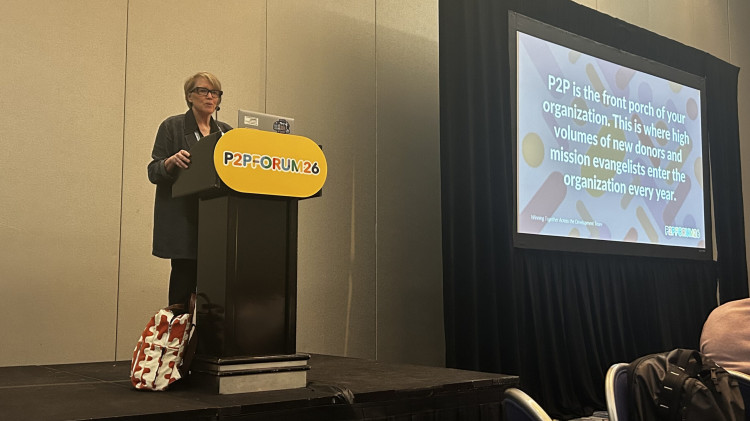

Peer-to-peer fundraising often serves as the front porch of an organization — the place where thousands of supporters first encounter the mission.
But what happens after supporters step inside depends on more than event performance. That was the message Tracy Evans, senior executive director of Obliteride at Fred Hutch Cancer Center, delivered at the 2026 Peer-to-Peer Professional Forum in the session “Winning Together Across the Development Team.”
At the heart of her remarks was a question of peer-to-peer donor conversion — whether organizations are intentionally structured to move event participants and first-time supporters into deeper, long-term giving.
“If we never get them in the door of the organization, we think they fall through the cracks,” Evans said, describing the scale and opportunity of peer-to-peer programs. “... Nobody wants that.”
At Fred Hutch, Obliteride engages roughly 5,100 participants and 25,000 donors annually, including about 12,000 new donors. The volume alone positions peer-to-peer as more than an event strategy. It is an entry point.
The question, Evans suggested, is whether organizations are structured to carry those relationships forward. Even for someone who does not hold the authority to institute change, she insisted they can still present the opportunity to initiate it.
“When your peer-to-peer program is based on a donor development journey, it's a really exciting time to change everything,” Evans said. “And we did. We changed everything behind the scenes last year that resulted in a 29% increase in participant fundraising …. It didn't mean that we said, ‘oh, we want to be separate from donor development.’ It really recognized the differences in the journeys.”
The Cost of Structural Disconnection
Evans framed the issue not as a conflict between teams, but as a structural challenge. She outlined three focus areas for addressing it: structure, alignment, and communication.
“There’s a disconnect many times in organizations between peer-to-peer and the rest of the development team,” she said.
That disconnect can manifest in subtle ways — prospect ownership questions, competing outreach, or unclear handoffs.
“The cost of internal disconnection can be duplicate outreach, mixed messages, territorial behavior, [and] lost opportunities,” she said. “Oftentimes, we think these are people problems, but likely they’re structural problems. Likely they come down to how the whole business unit is working together — or not working together.”
In peer-to-peer programs, where volume is high and timelines are fixed, those structural decisions matter. Participants may raise funds, make self-donations, or introduce new donors to the organization. Without clear coordination across teams, the broader development strategy may not fully capture that engagement. That handoff, she said, requires intentional action.
“We bring them to the door, and to get them through the door requires a lot of stewardship and acknowledgement and different things.”
Aligning Around Shared Goals
At Fred Hutch, one effort to address that disconnect has been aligning key performance indicators across business units.
“In the philanthropy plan, there’s a full dashboard full of the KPIs,” Evans said. “We are involved in one that’s shared across all business units, which is new donors.”
That metric is not owned solely by the peer-to-peer team. Direct response, digital, and other development units share responsibility for new donor growth. The shift reinforces collective accountability rather than isolated success.
Evans described how collaboration begins before event season. Teams review portfolios in March and identify participants who meet certain criteria. If a participant is already assigned to a major gift portfolio, the major gift officer serves as the lead.
When a participant makes a significant self-donation — for example, $25,000 — that gift triggers follow-up from a major gift officer.
“Their major gift officer is the person who is acknowledging that gift,” Evans said. “They're the person who is doing the follow-up and thank you on that gift.”
The goal is not to reassign ownership throughout the year, but to clarify roles in advance to improve collaboration. The event team can also acknowledge it, but their job, she said, is to steward event participants. Staff also keep others in the loop for donors whose file crosses over portfolios. Evans cited a donor who only attends events, yet has contributed $100,000 over 15 years. Since this donor could be a good prospect for a larger gift, the nonprofit may want to extend an invitation to a private gala.
“Because at the end of the day, we will all have great success if an Obliterider became a donor, got involved in the board of advisors, left something in their will, was a lifelong constituent of the organization, and became a mission fellow. Like, that's like the ideal, right? But we have to give them the opportunities along the way to get engaged and create those doorways to go through to the next thing.”
Reinforcing Collaboration Through Communication
The structural and cultural changes, Evans said, are designed with the long game in mind.
At Fred Hutch, when gifts of $1 million or more are secured, the organization holds bell-ringing moments at its monthly meetings to recognize the achievement. Those celebrations acknowledge multiple contributors, reflecting that significant gifts often result from cross-team cultivation.
“The frontline fundraiser gets up and talks about who the gift was from, what caused them to give, what the conversations were like,” Evans said. “And maybe the most important part of all of it is who all was involved in a relationship of that gift. And it is amazing to see how many times Obliteride is talked about.”
Designing for the Life Cycle
Evans returned repeatedly to life cycle thinking.
Peer-to-peer programs may introduce supporters at scale. But the opportunity extends beyond event revenue. With thousands of new peer-to-peer donors each year, even modest deeper engagement can have meaningful long-term impact.
“If we have even 2% that are like, ‘I want to learn more about Fred Hutch. I want to get more engaged,’ it’s still something,” Evans said.
Peer-to-peer may open the door. Whether supporters move further inside depends on how deliberately development teams define roles once they arrive.
“Be prepared to welcome everyone into the front door,” she said. “Build a structure that considers the life cycle of peer-to-peer participants and their donors, that it's not just about what we're doing today in this event, but that long term.”
- Categories:
- Giving Pyramid
- Major Gifts
- Peer to Peer
- People:
- Tracy Evans


