


State of Nonprofits 2026: 3 Dire Realities Facing the Sector Right Now


The nonprofit sector has endured a lot in recent years, but a new report found a significant escalation in 2025. The "State of Nonprofits 2026: What Funders Need to Know" report from The Center for Effective Philanthropy paints a picture of a sector under compounding pressure: more demand, less money, exhausted leaders and staff, and no clear path to stabilization. The last time nonprofits saw demand spike this sharply was 2020 — but then, the government and foundations both increased funding in response. Today, both have pulled back simultaneously.
The report draws on surveys of 380 nonprofit CEOs in February 2026 through the organization’s Nonprofit Voice Project, a panel of U.S. nonprofits receiving funding from at least one foundation giving $5 million or more annually. Here are the three realities that stand out.
1. CEO Burnout Has Hit a New High
The number of nonprofit CEOs and executive directors who say burnout is "very much" a concern jumped to 46% in 2026 — up from 29% in 2025. That's a 17-point increase in a single year.
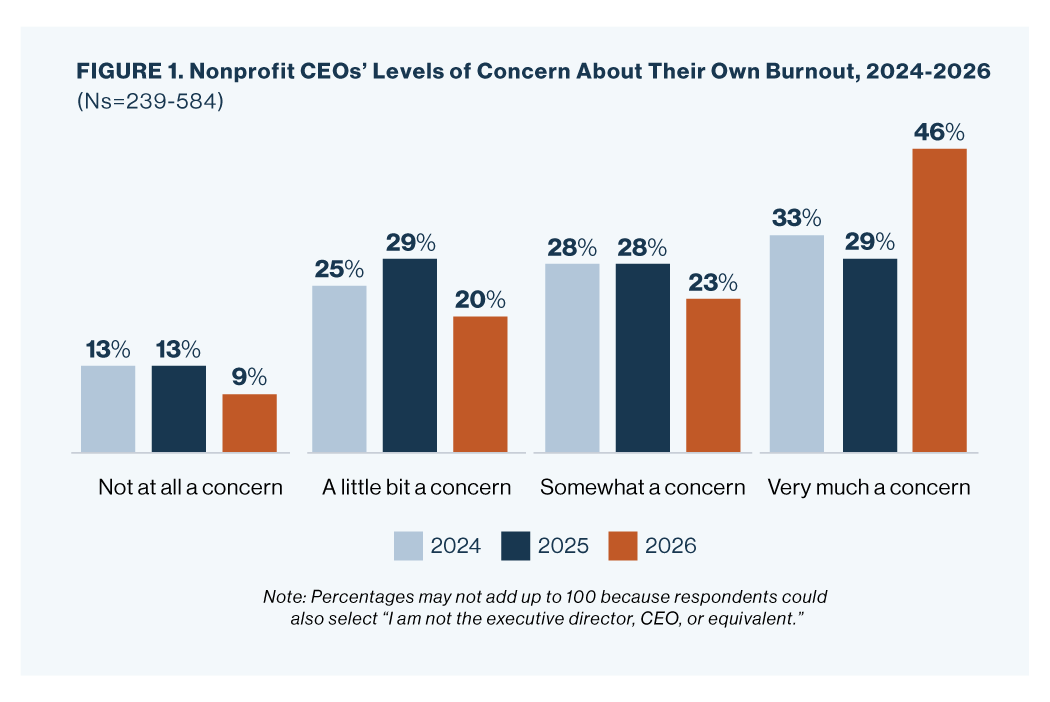
The share of nonprofit CEOs who say burnout is "very much" a concern jumped to 46% in 2026, up from 29% in 2025. | Credit: "State of Nonprofits 2026: What Funders Need to Know" by Center for Effective Philanthropy
"Burnout has intensified dramatically in the last year for nonprofit staff and leadership alike, as their organizations are faced with a combination of increased demand for their work and a tougher funding environment," Elisha Smith Arrillaga, Ph.D., vice president of research at The Center for Effective Philanthropy and report co-author, said during a webinar to launch the report.
The burnout isn't contained at the top. One quarter of CEOs say burnout is significantly impacting their staff — up from 17% in 2025, and 56% of leaders say they are managing their organizations in an atmosphere of increased fear and stress while simultaneously dealing with lower staff morale.
The causes are not abstract. Nearly three quarters of nonprofits (73%) have seen increased demand for services since January 2025. On the contrary, about 30% of nonprofits have reduced staff since January 2025. Cuts ranged widely — 43% of those organizations reduced staff by 10% or less, but nearly a quarter cut more than 25% of their workforce. Nearly half of leaders (45%) cite staffing as their organization's biggest challenge.
And the cuts don't stop at headcount — 26% of nonprofits have already reduced the services they provide.
"When funding revenue is insufficient or insecure, the staff feels it every day," one survey respondent said, according to the report. "They are the ones who must look into the eyes of someone seeking help and tell them that we cannot provide services for them. It is demoralizing ... As the leader, I am carrying the weight home every day."
2. Funding Has Dried Up From Every Direction
Nearly 60% of nonprofit CEOs say it has been harder to secure foundation grants since January 2025 — a higher rate than those reporting difficulty with federal funding (48%). That counterintuitive finding is one of the report's most significant: Foundations are not filling the gap the sector needs.
More than 40% of CEOs report reduced foundation funding, while 36% have seen less from federal sources and 34% from state or local governments. Organizations that experienced funding cuts from any government source were statistically more likely to reduce services; those with state or local cuts specifically were more likely to reduce both services and staffing. And the damage extends beyond organizations that relied on those sources directly.
"Although we are not directly impacted by loss of federal funding — because we do not and have not gotten federal funding — we feel the downstream effects acutely. Those who previously relied on federal funding are now turning to our existing donor base, resulting in overload for donors and less money to be distributed to individual organizations such as ours."
The result, as another leader put it, is “a scarcity mindset among nonprofits, which hinders our innovation, advancement, and mission-centered work."
3. Stopgap Measures Are Buying Time, Not Stability
Despite the pressure, nonprofits are not standing still — 88% of leaders are pursuing funding from new donors or funders, while 77% are engaging existing ones. Additionally, 46% of leaders are freezing planned staff compensation increases; 44% are drawing from reserve funds; and 34% are reducing programs or services. And some leaders are implementing "extreme budgeting" efforts to reduce overhead costs.
"[We are] cutting fat and tightening up operations," one leader told researchers. "But that also means we're all working at 175%, and it is not sustainable."
The bottom line: 39% of nonprofits ran a deficit in fiscal year 2025, up from 22% in 2022. Two-thirds of CEOs have concerns about their organization's financial stability. Organizations that experienced foundation funding cuts are statistically more likely to project a deficit in 2026.
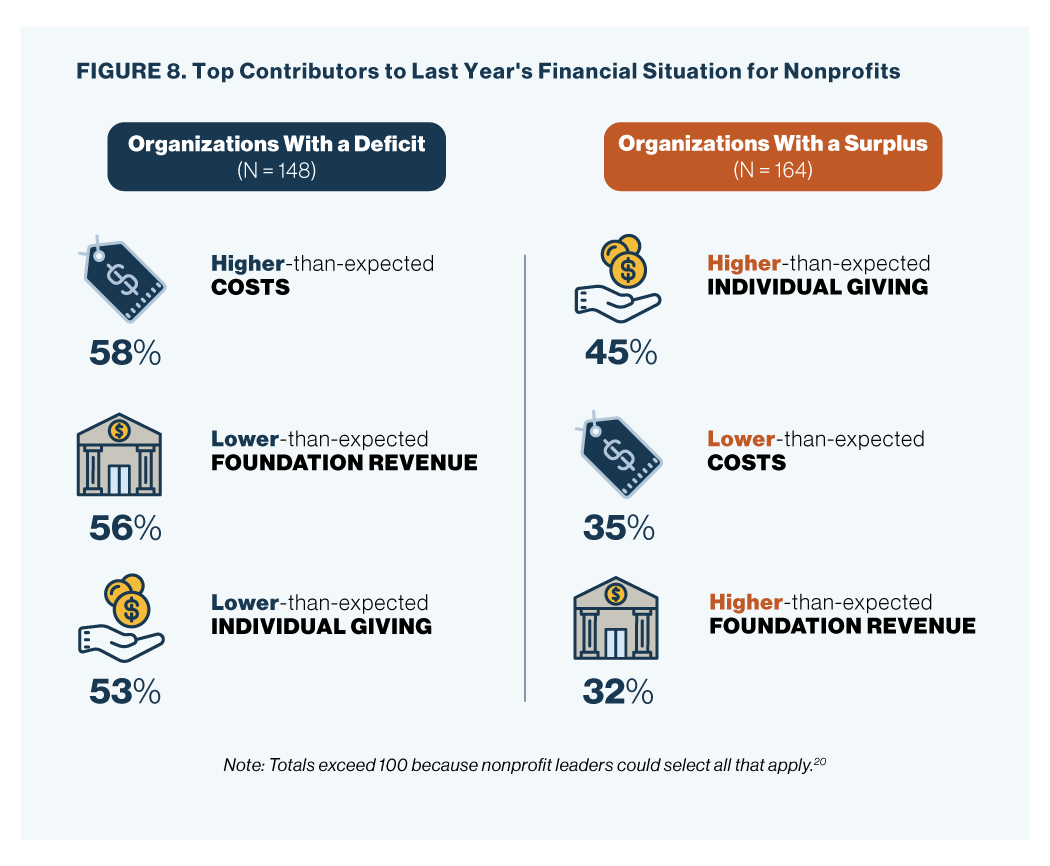
Among nonprofits that ran a deficit in FY2025, 56% pointed to lower-than-expected foundation revenue as a top factor. Among those with a surplus, 45% credited higher-than-expected individual giving. | Credit: "State of Nonprofits 2026: What Funders Need to Know" by Center for Effective Philanthropy
But the same data that maps the crisis also points to where organizations are finding traction. Among organizations in deficit, 56% cited lower-than-expected foundation revenue and 53% attributed lower-than-expected individual giving as top contributors. Among those that ended the year with a surplus, 45% credited higher-than-expected individual giving — and 32% noted higher-than-expected foundation revenue.
That surplus data offers the clearest signal in a lot of noise: Organizations that cultivated individual donor relationships had a buffer when foundation and government funding fell short. In fact, 40% of CEOs say actively fundraising was the single most important action they took. And half of them stressed the importance of the strategy many nonprofits learned during the pandemic, when event revenue dropped to zero overnight — diversifying revenue.
"We have started to prioritize diversifying our funding streams as much as possible," one CEO told researchers. "This includes identifying and applying for novel grants, working to expand our individual donor base, and pursuing opportunities through funding co-ops."
For many organizations, these moves are buying time, not building stability.
"We're all terrified and barely holding it together," a CEO told researchers. "We find solace in each other and our work but just existing is exhausting these days."
- Categories:
- Executive Issues
- Financial Services
- Grants
- People:
- Elisha Smith Arrillaga


