


Nonprofits Say Foundation Funding Didn’t Meet Expectations in 2025, New Data Shows


As government and individual funding streams weakened in 2025, the nonprofit sector looked to foundations as a possible backstop — a source of stability in a volatile revenue environment. But new research reveals that while foundations made some important adjustments in response, their actions often couldn’t fully offset the scale of nonprofit shortfalls or meet the high expectations nonprofits had for filling those gaps.
How Expectations and Realities Came Together
Nonprofits entered 2025 under intense pressure. The Center for Effective Philanthropy’s research, “A Sector in Crisis: How U.S. Nonprofits and Foundations Are Responding to Threats,” shows that nearly two-thirds of nonprofit leaders reported increased demand for their services as a result of “the current context,” meaning the series of legislative actions, executive orders, and budget decisions the federal government initiated in 2025, according to researchers. At the same time, nearly 70% reported a reduction of funds from at least one source, such as government, foundations, or individual donors.
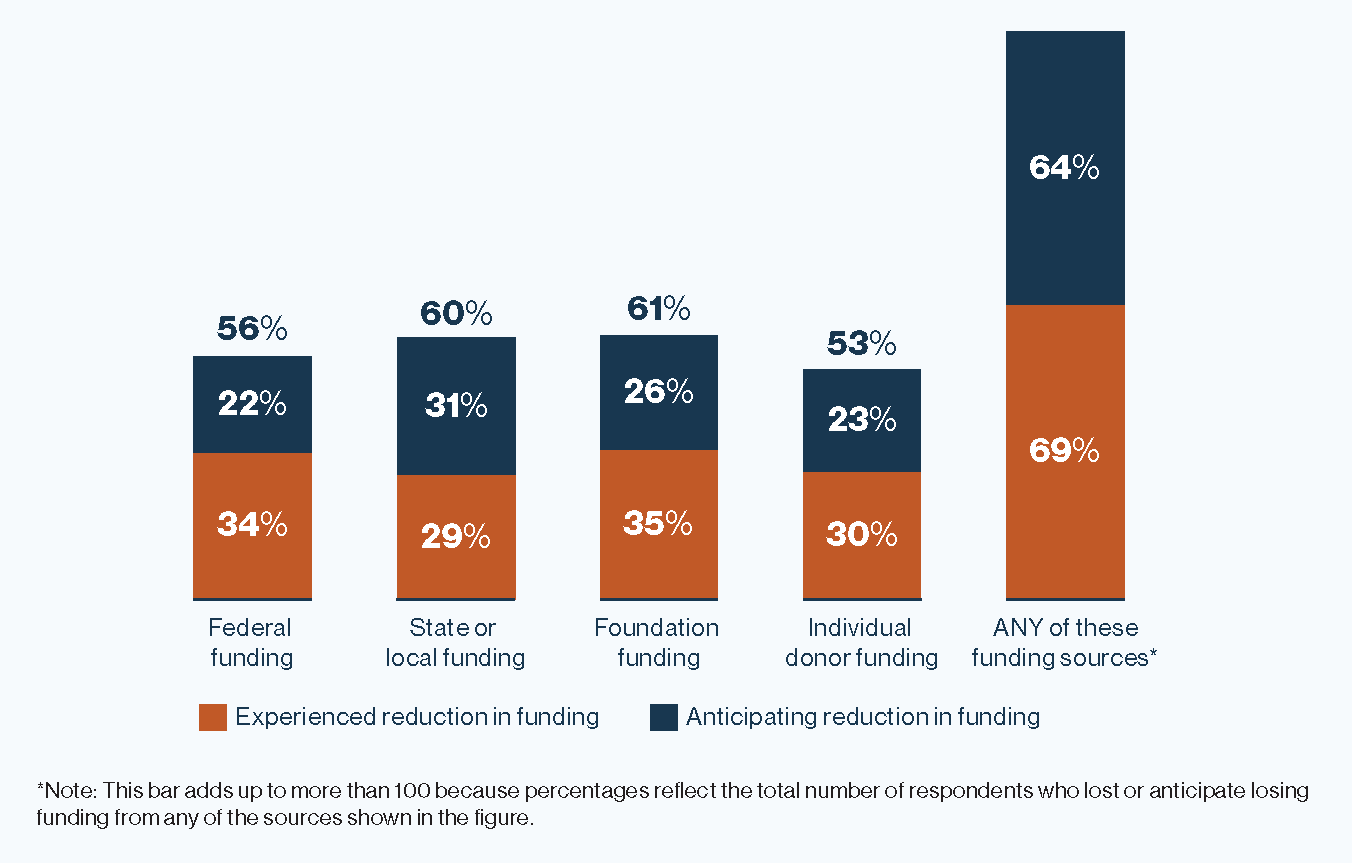
Nearly 70% of nonprofits reported funding reductions from at least one source, including government, foundations, or individual donors, according to research from The Center for Effective Philanthropy. | Credit: “A Sector in Crisis: How U.S. Nonprofits and Foundations Are Responding to Threats” by Center for Effective Philanthropy
Many nonprofits responded by pursuing new or increased support from existing funders and donors and drawing from reserve funds. Even so, many nonprofits indicated they were unable to secure funding at a level sufficient to fully offset those losses.
Where Foundations Stepped In — and Where Limits Appeared
Foundations did adjust their practices in response to nonprofit needs in 2025. A significant share — nearly two-thirds — reported providing emergency or rapid-response grants, and many also increased unrestricted giving and streamlined application processes to offer more flexibility.
CEP’s findings suggest that a meaningful share of foundations made notable adjustments in response to nonprofit strain. Nearly 30% of foundations reported increasing their payout beyond what was originally planned for the year, with a median increase of 2 percentage points. Given the 5% minimum payout requirement, those increases represent a substantial infusion of additional dollars.
Foundations also continued a shift toward flexibility that began during the pandemic. More than four in 10 foundations increased unrestricted support, and more than a quarter expanded multiyear funding commitments. While these changes were not universal, they signal a continued evolution in grantmaking practices rather than retrenchment.
Importantly, The Center for Effective Philanthropy’s research suggests foundations were far from unified in how they viewed the adequacy of these responses. Only about 40% foundation leaders said they believe their peers are doing enough to help nonprofits weather the current moment.
Some foundation leaders were explicit about the limits they believe philanthropy should observe, emphasizing that foundations should not be expected to replace lost government funding. One foundation leader told researchers, “Our board agreed that we were not going to replace lost federal funding because of [our] position being that we don’t believe it’s the role of philanthropy to do the role of government.”
The Gap Between Expectation and Reality
The heart of the issue isn’t whether foundations tried — many did — but whether their responses could realistically meet nonprofits’ expectations in a context of compounded revenue losses.
Foundations often play a crucial support role. But The Center for Effective Philanthropy’s data shows this support tended to function as relief rather than replacement: Short-term or responsive measures that helped stabilize a moment but didn’t erase structural deficits caused by broader funding contractions. Importantly, researcher interviews indicate this approach was intentional. Some foundation leaders were clear that philanthropy was not meant to serve as a stopgap or to replace lost government funding, even amid significant nonprofit strain.
This distinction matters because it underscores a basic reality of nonprofit finances: No single funding source — not government, not individuals, and not foundations — can single-handedly absorb systemic shortfalls across the sector. What foundations can realistically offer is important — flexibility, rapid relief, and targeted support — but not full replacement of lost public or private revenue streams.
This moment differs from researchers’ 2014 report when nonprofits and foundations reported greater alignment around sector challenges and philanthropy’s role. Ultimately, The Center for Effective Philanthropy’s recent research doesn’t suggest that foundations failed to respond. Rather, it highlights a mismatch between sector expectations and the bounds of foundation capacity as nonprofits confront a challenging financial landscape.
- Categories:
- Government & Regulation
- Grants


