Supersized Gifts Mask Declining Nonprofit Grassroots Support, Q1 FEP Report Finds


The dollars up, donors down trend continues as the latest fundraising data shows the donor pool is continuing to shrink.
Total giving grew 3.6% in the first quarter over the same timeframe in 2024, yet the number of donors fell 1.3%, and retention was relatively flat at 18.1%, according to the just‑released analysis from the Fundraising Effectiveness Project (FEP) that covers the first quarter of 2025.
The report, published by the Association of Fundraising Professionals (AFP) Foundation for Philanthropy and GivingTuesday, aggregates data from a dozen donor databases, providing estimates that account for late data. The current dataset relies on 2.4 million donors giving $2.6 billion to more than 15,000 nonprofits.

The rate of donor decline was lowest in January, which may have represented a slight increase in donors as compared to January 2024, after adjusting for late data. | Credit: "Fundraising Effectiveness Project Quarterly Fundraising Report" by Association of Fundraising Professionals Foundation for Philanthropy and GivingTuesday
A gain in dollars during the historically sluggish first quarter may suggest giving resilience even in an uncertain economy. However, the reality is that nonprofits must adapt to achieve strong fundraising results at the end of the year with innovative approaches to acquisition, retention and stewardship.
“In a year marked by shifting government priorities and uncertainty in federal funding, the need for timely, reliable data has never been more urgent,” Art Taylor, president and CEO of the AFP, said in a statement. “The Fundraising Effectiveness Project is a powerful example of sector-wide collaboration, providing insights that empower fundraisers to understand and adapt to trends like the continued decline in donor participation. Sharing this collective data helps individual organizations make informed, resilience-oriented decisions, and equips our sector to advocate more effectively for policies that strengthen long-term nonprofit impact.”
Small-Dollar Donors Still Aren’t Showing Up
The year-over-year monetary growth is smaller than the 5.2% increase recorded in the first quarter of 2024, but it reflects the gains made last year that resulted in a higher starting point.
Larger gifts continue to mask the erosion in grassroots support.
“As we've seen in previous quarters, the continued decline in small donor participation reveals a deep vulnerability, especially at a time of growing volatility for the nonprofit sector,” Woodrow Rosenbaum, chief data officer at GivingTuesday, said in a statement. “Now, ahead of giving season, is the time to invest in unlocking the billions of dollars in untapped opportunity within the everyday giving market.”
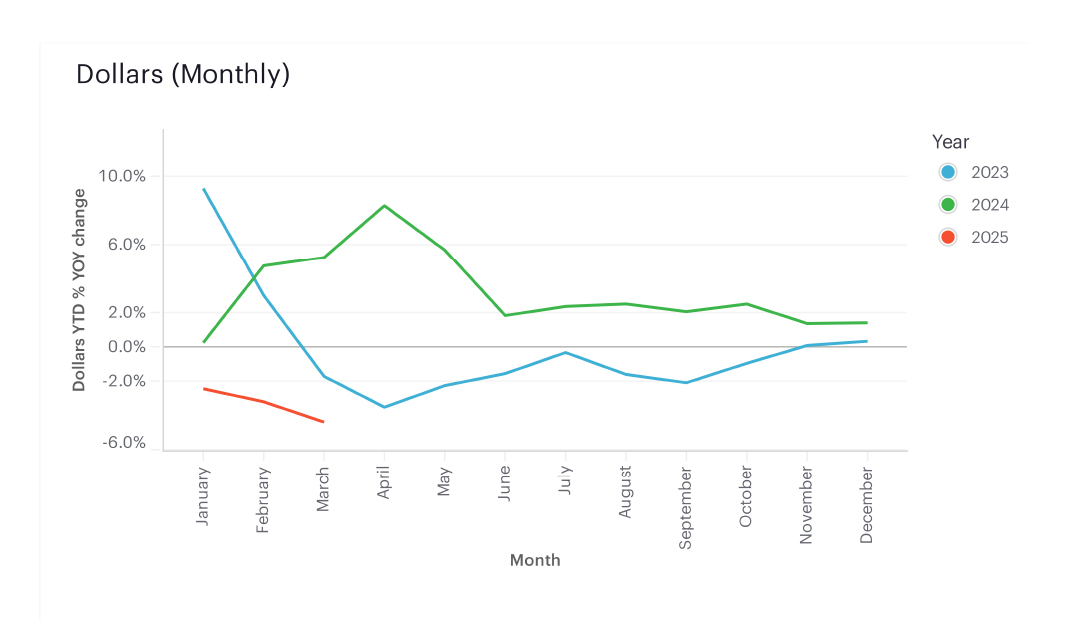
Similar to donor numbers, the latter two months of Q1 2025 saw weaker fundraising performance than in January, as compared to the same months last year. | Credit: "Fundraising Effectiveness Project Quarterly Fundraising Report" by Association of Fundraising Professionals Foundation for Philanthropy and GivingTuesday
Rosenbaum’s warning is reflected in the data. Micro donors — who give less than $100 — represented 57% of all contributors but plummeted 11.1% in headcount and 10.4% in revenue. In other words, the very constituents most nonprofits court through email acquisition, social media campaigns and peer-to-peer events departed in large numbers during the first quarter — an issue that researchers noted is common at the onset of each calendar year.
While supersize donors — those giving more than $50,000 — still supplied nearly half of total dollars, their giving slipped 5.9% year over year. Major donors — those giving $5,000 to $50,000 — represented about a quarter of revenue. Their giving declined only 1.5%.
This shows high-value supporters continued to give, but didn’t fully offset grassroots losses. If the supersize donor segment cools later in the year, organizations banking on a handful of large gifts could feel the pinch.
Nonprofits Struggle to Obtain Second Gifts and Bring Back Lapsed Donors
Donor acquisition remains soft with new donors having dropped 10.9%, and new-retained donors (first-time donors in 2024 who gave again) having fallen 11.4%.
Meanwhile, loyal repeat-retained donors had a less severe drop of 6.1% and now comprise just over half of an organization’s donor file.
Overall, the low 18.1% retention rate — a revamped data point in the report — hides deeper concerns:
- New donor retention is only 7.1% — slightly worse than last year.
- Repeat donor retention bumps up to 25.4%.
- Recapture rates — converting lapsed donors — are stuck below 1%.
“While the continued decline in donor retention and individual giving reflects long-standing challenges in the sector, they also point to tremendous opportunity," Keith Reed, CEO of Neon One, said in a statement. "We know that, when nonprofits successfully engage supporters over time, those donors don’t just stay involved — they also increase their generosity. The Q1 FEP report gives our sector both a mandate to invest in meaningful, sustained donor relationships and a roadmap for doing so.”