


How Direct Mail and Donor Data Can Help Build Your Major Gift Pipeline


Nonprofits face a dual challenge: meeting today’s fundraising goals while cultivating lasting relationships that lead to major gifts tomorrow. That means identifying high-potential prospects already in the donor file — while also building a pipeline that helps small-dollar donors grow into major supporters over time.
It’s a delicate balance, especially with limited capacity and competing program priorities. But sessions at the 20th annual Bridge to Integrated Marketing and Fundraising Conference — co-hosted by the Direct Marketing Association of Washington (DMAW) and the Association of Fundraising Professionals Washington DC Metro Area Chapter (AFP DC) — offered practical strategies for doing both.
Here’s how nonprofits can reimagine major giving through a mix of personal touch and precision data.
1. Elevate Donors Through Your Direct Mail Program
Major donors rarely start with a large check — they typically begin at lower levels through your direct marketing programs.
“So, the strongest direct marketing fundraising programs have different paths for donors to follow,” Margaret Carter, senior account director at O’Brien Garrett, said. “And so donors don't always join at mid-level. They usually upgrade their giving through multiple appeals and ask-string optimization. But once a donor is at mid-level, they continue to deepen their relationship, and then they can become a major or planned gift donor.”
While mid-level donors may still receive frequent mailings, they’re solicited less often with optimized ask strings based on the donor’s highest past contribution. Packages often include first-class postage, upgraded materials and content emphasizing long-term impact as opposed to urgency. Tools like welcome kits, member cards and impact reports help deepen connection and loyalty.
Handwritten touches can help to upgrade donors, too. For years, Ryan Treacy, integrated fundraising specialist at The Seeing Eye, has personally signed acknowledgement letters to donors giving between $250 and $999.
“I will try to write a whole paragraph on each letter,” he said, admitting the task peaks at 100 to 200 acknowledgements a week during January. “And after doing this for many years, … some of the donors have started to recognize my name [at our events], and thank me for the development letter that I sent them. And so even though I'm not a major gift officer, I start to form a meaningful relationship with these donors, help them feel more connected to us and also help fuel the pipeline.”
Even after donors enter major gift portfolios, targeted direct mail can still play a role. At The Seeing Eye, coordinated efforts between fundraising and major gifts teams ensure that managed donors receive personalized campaigns. Each November, a curated package includes a calendar, membership card, beneficiary story and handwritten note.
“What we'll do is, if the person has made their gift already during that year, we won't make an ask,” Kara Orlando, major gift officer for The Seeing Eye, said. “It'll just be a ‘Thank you so much for your support,’ if they haven't made their gift throughout the year — because … they probably go out by mid-November. So anyone who typically makes their gift in December will include a [business reply envelope], so it's a soft ask.”
2. Prioritize Clean Data
Data hygiene can be overwhelming — especially for smaller, but quickly growing nonprofits. Movement 4 Black Lives, formed after the 2014 death of Eric Garner, rapidly expanded its donor base as more police brutality cases drew national attention in 2020 and eventually attracting individual donors giving $1 million or more.
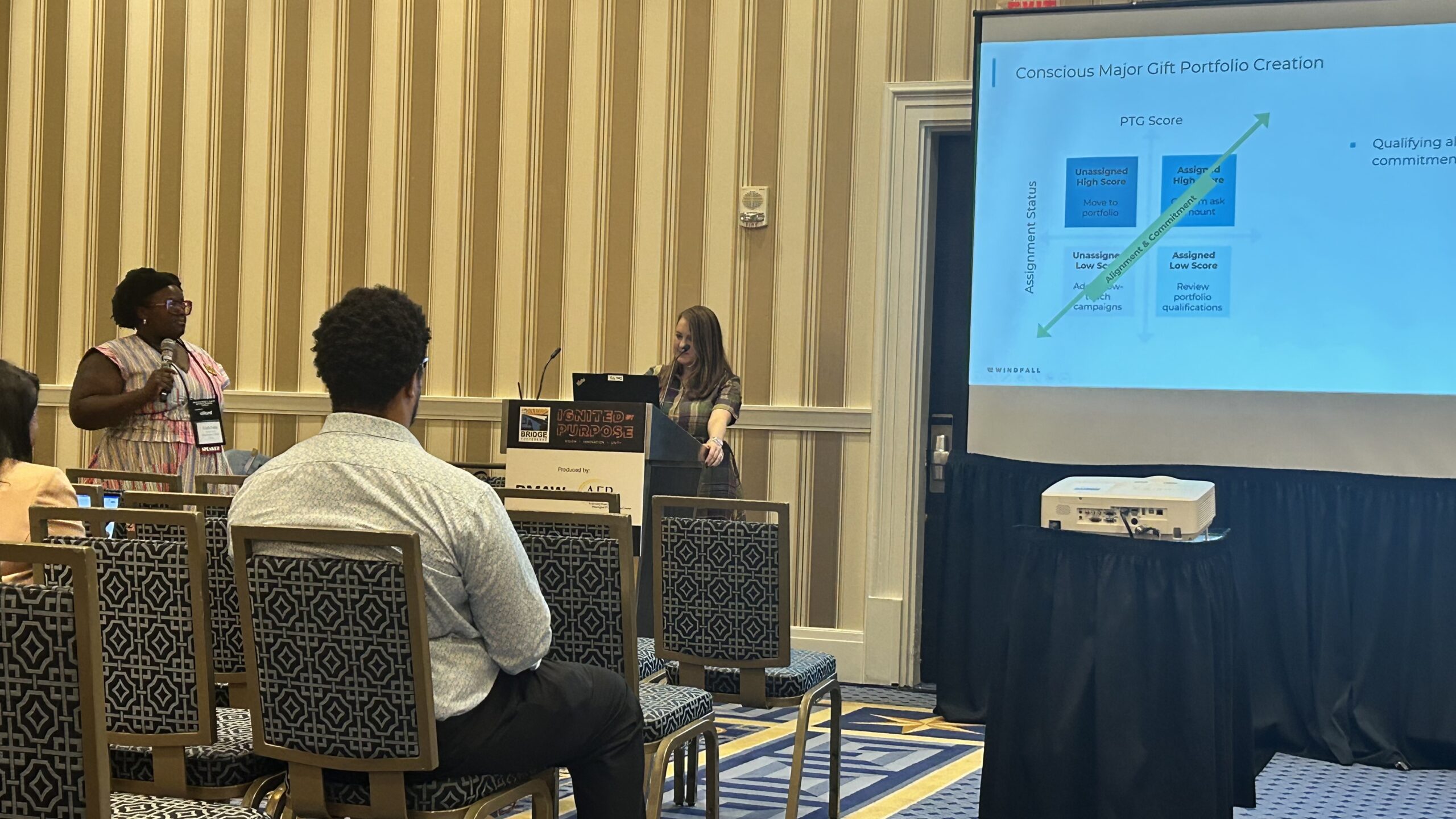
Gabrielle Anthony (left), development operations lead at Movement 4 Black Lives, and Marissa Maybee, director of nonprofit customer success at Windfall, discuss data and major gifts at the 20th annual Bridge Conference. | Credit: NonProfit PRO
“Prior to that, we were accepting very little," Gabrielle Anthony, development operations lead at Movement 4 Black Lives, said. “So to go from having a couple of donors you have to steward to having millions of records, what do you do with them? … So we were sitting on a lot of information with very little idea of what to do with it.”
At the time, the organization was largely volunteer-run, with no major gifts strategy and more than 1 million donor records.
“So the data was messy,” Anthony said. “It's in its early days. There's a lack of history, so we only have a couple of months of someone's giving data or maybe even just a few years. So there's not really a lot that we were pulling from.”
To begin organizing, the team exported their CRM data and worked with Windfall to clean and append it. That enabled them to begin segmenting and building a prospect pipeline. Cleaned and enriched data helped guide the nonprofit on where to invest time, as well as how to activate donors based on where they spend their time and have assets.
For example, what began as a two-day meet-and-greet in Massachusetts evolved into a two-week cultivation strategy, with custom portfolios assigned to every staff member in Martha’s Vineyard, timed during the Martha’s Vineyard African American Film Festival this month.
“So we were really orchestrating these gifts based on the propensity-to-give scores,” Anthony said. “… So up until now, I've been spending a lot of time, of course, putting together our portfolios for our frontline fundraisers so that they feel well-equipped to go into these rooms.”
3. Unlock Long-Term Potential With Matching Gifts
Matching campaigns offer a powerful opportunity to reengage donors and inspire larger commitments. Treacy shared how one long-time supporter evolved into The Seeing Eye’s most impactful match donor.
After making a first-time gift of $1,000 two decades ago, the husband-wife duo steadily increased their giving. For the past 10 years, their annual gift remained around $50,000. But for the past five years, the donors agreed to use their gift as a match for The Seeing Eye’s summer campaign. That match grew to $100,000 last year.
“They were so enamored with us and our new CEO [Karen E. Leies] we have now,” Treacy said. “They were really impressed by the program. They doubled it again to $200,000, which is, as far as I know, the biggest match we've been involved with. … So they've been great donors.”
The key was not just the match itself, but the stewardship and communication around it.
“I communicate with this donor many times a year. I reach out to her, usually a couple months beforehand, to see if they’re interested in doing it again. They [have] never said ‘no,’” Treacy said. “Hopefully, they’ll keep it going for many years to come.”
4. Surface Hidden Gems With Wealth Data
While mid-level cultivation opens the door, precise data helps determine where to focus. But simply identifying affluence isn’t enough, said Marissa Maybee, director of nonprofit customer success at Windfall.
“Someone being affluent is a lot of steps removed from someone actually making a major gift to your organization, right?” she said. “Are they affluent? Are they philanthropic? Do they support causes like yours? And then the really big question is, are they going to make an actual gift of that size to your organization specifically?”
That’s why Movement 4 Black Lives combined wealth intelligence with values-based segmentation when building its first major gifts framework. After importing data on more than 1 million donors and syncing it with Windfall insights, the team curated a portfolio of 250 top prospects — prioritizing capacity, modeled propensity to give and mission alignment.
For Movement 4 Black Lives, one of the most powerful wins came not from a new acquisition — but with a lapsed major donor.
“They’d gone silent on us,” Anthony said. “That happens occasionally, as we all know, but the team’s outreach went unanswered for quite a while, and they were unsure if … the donor was still a viable option.”
Ordinarily, the donor might have been deprioritized. But when they received a propensity-to-give score of 99, the team doubled down. After discovering the donor’s affiliation with a family foundation — and securing an introduction — the organization landed a seven-figure gift.
“That data really showed that there was a significant opportunity for [us] to go after and be persistent about where we’re focusing our efforts,” Anthony said. “… We might give up after three years [of] reaching out to a donor, but … that was, I think, a really great example of how that data led to something great for us.”
- Categories:
- Direct Mail
- Major Gifts


