


Are There Too Many Nonprofits? How Density Data Helps Leaders Assess


Can the number of nonprofits in your neighborhood help predict your safety and well-being?
From reducing crime rates to boosting civic engagement, nonprofit organizational density can be a vital indicator of community health. And more is not always better.
The New York City metro area has more registered nonprofits than any other metro area in the nation. That statistic is not surprising. What is surprising is that among the top 10 largest metro areas, New York ranks fifth in organizational density. The Washington, D.C., metro area has the highest concentration of organizations per 10,000 residents — 30% greater than New York City.
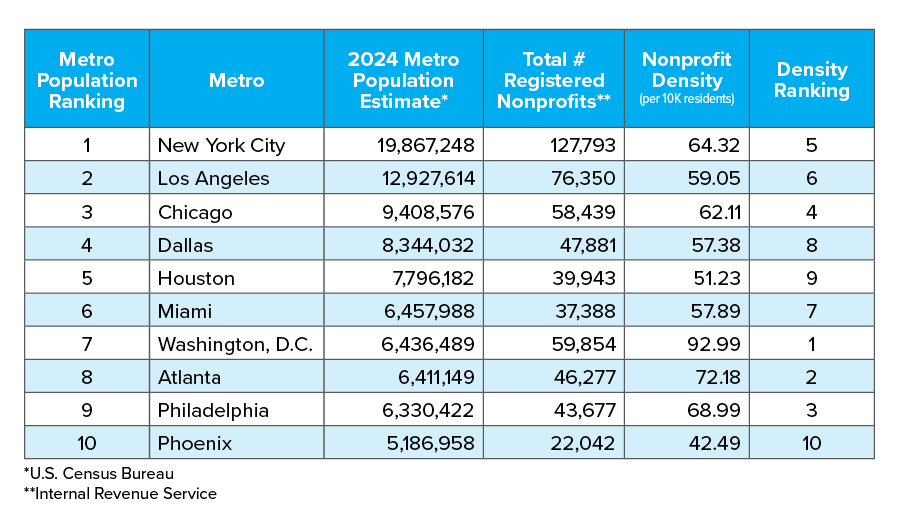
Nonprofit density varies across major metro areas, with Washington, D.C., leading in nonprofits per 10,000 residents, while New York City has the largest total number of organizations.
This data raises an important question: Are there too many nonprofits?
What Is Nonprofit Density?
Nonprofit density refers to the total number of tax-exempt organizations relative to population within a city or region. It essentially explains how many nonprofits exist in relation to a specific population or land area.
Researchers and academics use this measurement to analyze the size and scope of the sector. The higher the density, the more organizations there are per resident.
Studying density can help identify current and needed services, such as gaps in support for housing or mental health. Funders and policymakers can use density data to identify service deserts and the need for additional support.
How Can Density Impact Communities?
High nonprofit density — a large concentration of organizations — can be a sign of community wellness, suggesting a region has a strong network of organizations responding to local needs. Studies have shown that nonprofits play a critical role in fostering civic engagement and social capital within communities. Areas with high density are known to have better safety nets and civic infrastructure. Nonprofits create opportunities for residents to volunteer, develop connections, and improve leadership skills.
On the contrary, neighborhoods with low nonprofit density may lack social connectedness. Social disorganization theory, developed by sociologists at the University of Chicago, suggests that communities with fewer institutions and weaker social ties are more likely to experience higher levels of crime and disorder.
Community leaders and funders should pay attention to nonprofit density. This data is useful for planning and investing. As community demographics and cultures evolve, the need for more — or different — programs and services may arise.
Nonprofit density can also help explain broader patterns in community well-being. It can be linked to four well-being indicators, reinforcing its role as a broader indicator of community health:
- Health equity.
- Conservation protection and preservation.
- Cultural vitality.
- Social capital.
How Many Organizations Should There Be?
The question of how many nonprofits a community needs does not have a simple answer. It depends on whether the programs and services currently being offered are adequately meeting community needs. Other key determinants may include:
- Size and complexity of current (and projected) community needs.
- Presence and capacity of existing nonprofits.
- Funding environment.
- Current and projected community growth.
There are instances when a large concentration can have a negative outcome. Higher nonprofit density can mean more competition for the same pool of supporters, grants, board members, volunteers, and government funding. Organizations may struggle to differentiate themselves or may duplicate services.
What Drives Nonprofit Density Beyond Population?
While smaller, less populated areas often have fewer nonprofits overall, the data shows that nonprofit density varies across communities of similar size.

Smaller communities show wide variation in nonprofit density, highlighting differences beyond population size.
Low nonprofit density in less populated areas could be the result of several conditions, including:
- A philanthropy gap. Major foundations are frequently located in cities, and philanthropic efforts often focus on those regions, leaving smaller communities with funding gaps.
- Business concentration. Major corporations and businesses are often located within large metro areas, resulting in a deeper pool of donors and engaged stakeholders.
- Talent pool. Smaller communities may lack skilled staff and other resources necessary to develop and operate organizations.
When resources are scarce, residents of smaller regions are forced to commute to other cities where services are provided. Or worse, needs may go unmet.
Tools for Assessing Community Need
There are several tools that can be useful in analyzing a community’s need for organizations.
- Community needs assessment. This assessment collects vital statistics such as population and cultural trends, income, and specific needs like housing, food security, and transportation.
- Community Resource Directory. This directory provides a centralized database or document to inform the community of social service providers. It includes basic contact information and an overview of programs and services for each resource. For reference, the Madison Public Library in Wisconsin provides a resource directory for the community.
- Resource mapping. This visual representation identifies organizations currently providing programs and services to address a specific need or issue. It shows the interconnection among institutions, and in some cases, how certain needs are underserved or overserved. For example, The United Way of Greater Los Angeles produced an interactive resource map to assist the community in locating resources.
- Demand versus capacity. This approach compares the level of need to the ability of existing organizations to meet demand without delays or resource strain.
These tools can be insightful for leaders as they seek to identify issues and assets, avoid duplication of efforts, and plan for the future. In addition, conducting focus groups and listening sessions can help identify perceived needs.
Nonprofit density is an important indicator, but it only tells part of the story. What matters most is not how many nonprofits exist, but how effectively these groups work — both independently and collectively. High-performing organizations demonstrate how their programs and services create measurable change for individuals and communities.
Ultimately, the focus should shift from quantity to capacity and quality. Cities don’t necessarily need more nonprofits — they need stronger support from funders, policymakers, and leaders to help them carry out their work and transform communities. Nonprofit density is most useful when it helps leaders understand where capacity — not just quantity — needs to grow.
The preceding content was provided by a contributor unaffiliated with NonProfit PRO. The views expressed within may not directly reflect the thoughts or opinions of the staff of NonProfit PRO.
- Categories:
- Mission Impact
- Programs
- Strategic Planning


