How RCS Can Elevate Nonprofits’ Text Messaging

It’s no wonder nonprofits have eagerly added texting to their omnichannel communications. Text messages boast a 98% open rate, with 90% of people opening a text within three minutes.
While the standard has long been short message service (SMS) or multimedia messaging service (MMS), rich communication services (RCS) is starting to catch on.
Built by Google, RCS is backed by the Global System for Mobile Communications Association (GSMA) and mobile carriers around the world. Research estimated there would be more than 2.5 billion monthly active RCS users around the world by the end of 2024. While Androids have supported RCS since its inception, Apple began supporting RCS in September.
“That means that we can finally bridge the Android-Apple messaging gap, which, particularly in the U.S., has been really critical to the widespread adoption of RCS,” Krishna Ghodiwala, partner at Message Digital, said during a session at BridgeTECH, an event co-presented by NonProfit PRO, the Direct Marketing Association of Washington (DMAW), and the Association of Fundraising Professionals Washington DC Metro Area Chapter (AFP DC).
Here’s a closer look at how RCS works, plus the opportunities it holds for nonprofits.
What Is RCS?
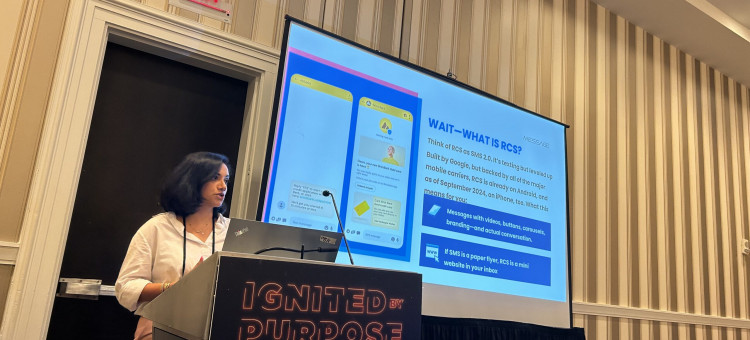
Like SMS and MMS messages, RCS messages appear in your recipients’ native messaging app. Nonprofits can continue to use their same phone number, Ghodiwala said, but with RCS, they can use additional engaging features like videos, high-resolution pictures, interactive buttons and more.
“Simply put, if you look at SMS as a paper flyer, RCS is like having a mini website in your inbox,” she said during the session, “RCS: The Future of Messaging.” “Everything is built-in, seamless and a lot more dynamic. If you have used WhatsApp or some of these other OTT [over-the-top] platforms, the experience is going to feel a lot more similar to that.”
And while over-the-top platforms such as WhatsApp require users to download a particular app to receive a message, RCS works like SMS via your donors’ phone numbers.
Depending on your nonprofit’s needs and capacity, there are four different levels of RCS that may work for you.
Basic RCS. This is much like a normal SMS message, but also offers typing indicators and read receipts. This is a good first step into RCS, Ghodiwala said.
Single-content RCS. This is like an MMS where you can add images and videos. However, you can also add a call-to-action (CTA) button.
Conversational RCS. This adds on to single-content RCS by enabling two-way conversations with supporters.
RCS business messaging. This takes things a step further, allowing nonprofits to appear as a fully branded, verified sender in constituents’ messaging apps, to use carousels and to send quick replies. Ghodiwala said these are great for high-stakes campaigns.
RCS Compliance
Since organizations must register to use RCS, there should be no deliverability issues, Ghodiwala said. However, she noted that registration and compliance guidelines for RCS are still in flux, so working with your provider can help keep you up to date on the latest requirements.
As of July 30, requirements for registration included:
- Brand details.
- Logo.
- Display name.
- Opt-in and opt-out plan.
- Link to existing SMS registration as a fallback in case someone’s phone doesn’t yet support RCS messages.
Ghodiwala said a full rollout of RCS messaging in the U.S. is expected in the first quarter of 2026. Because the registration review process can take up to three months, she encouraged nonprofits to begin the process sooner rather than later.
How Nonprofits Can Use RCS
RCS includes several features that can help nonprofits tap into their supporter base. Ghodiwala explained that the usefulness of each of these features depends on your organization’s needs and goals.
Here are three potential uses for some of RCS’ key features.
1. Fundraising Drives
Ghodiwala highlighted fundraising as the main opportunity for RCS. By using RCS, nonprofits can send rich media like images or videos, which can be used to share impact stories.
“If you have a beautiful new video that you've released, you can push out all of that rich media without paying that heftier price that comes when you're doing traditional SMS and MMS two-way engagement,” she said.
For the fundraising piece, RCS enables nonprofits to include a simple CTA button alongside rich media components. Not only can this boost conversions and reduce friction on the back end compared to a traditional tracked hyperlink, but it also helps center the emotional side of things.
“So it's cutting down that friction,” Ghodiwala said. “It's making it faster.” You're keeping that emotional momentum, and it's just simplifying the number of steps in that conversion. Some nonprofit pilots have seen over 50% increase in their donation conversion versus using traditional SMS or MMS.”
2. Two-Way Communication With Supporters
RCS is also great for fostering relationships. Compared to SMS, conversational RCS eases the financial burden of sending messages back and forth with supporters.
Currently, with SMS and MMS, “you're paying for each of those interactions,” Ghodiwala explained. “With conversational RCS messaging, you pay for that initial message, and essentially you're opening up a chatbot of sorts, and then every interaction back and forth over a 24-hour period, I believe, is included.”
In practice, that means nonprofits can use RCS for deeper engagement with donors, volunteers and other supporters. For example, Ghodiwala said that conversational RCS is great for onboarding new volunteers, or “if there's a key moment happening for your organization and you want to welcome your supporters to ask questions about next steps.”
3. Event Promotion
Event promotion is another area where Ghodiwala sees potential for RCS. For one, location sharing is coming to RCS soon.
“You can have the map, which links straight from the message, and so it's going to cut a lot of that friction down,” she said.
Plus, nonprofits can use interactive buttons — like the CTA fundraising buttons mentioned previously — to streamline event registration.
“Recipients just have to tap a button or two,” Ghodiwala said. “They can RSVP, they can add it to their calendar, and they can also check the location. So this, again, is going to improve, because they're not having to get multiple clunky redirects, and everything is happening in one place.”
Kalie VanDewater is associate content and online editor at NAPCO Media.