How Donor-Advised Funds Are Bringing Big Results to Fundraising Across the Board


Donor-advised funds (DAFs) have soared in popularity over the past few years.
“This has been … really popular lately because donors do receive that immediate tax benefit when they give to the donor-advised fund,” Danielle Felico, production manager for the President’s Circle mid-level giving program at Planned Parenthood Federation of America, said. “But one of the biggest things that I've heard from DAF donors is that it's a really great way to consolidate their giving. So if you were going to give to, let's say, five nonprofits this year, that would be five tax forms that you would have to submit. Instead, you only have to do one with a DAF.”
The nonprofit sector continues to discover how to take advantage of DAF giving as part of their fundraising strategies. Here’s a look at how DAFs can play a role in two development areas — mid-level and peer-to-peer giving — gleaned from sessions at the 20th annual Bridge to Integrated Marketing and Fundraising Conference, co-hosted by Direct Marketing Association of Washington (DMAW), and the Association of Fundraising Professionals Washington DC Metro Area Chapter (AFP DC).
Mid-Level Donors
Planned Parenthood recently dove headlong into the world of DAFs, specifically for its President’s Circle mid-level program, which includes donors giving $1,000 to $24,999 annually.
According to Tara Kowsaluk, associate vice president at MissionWired, 90% of Planned Parenthood’s DAF donors only give via DAF.
To tap into the DAF donors in the President’s Circle, the nonprofit has started using DAF-centric language in its appeals. Its first campaign that focused on this was a direct mail campaign run in September in the leadup to the inaugural DAF Day. For the campaign, Planned Parenthood included DAF messaging on the outer envelope, in the letter and on the front of the reply device.
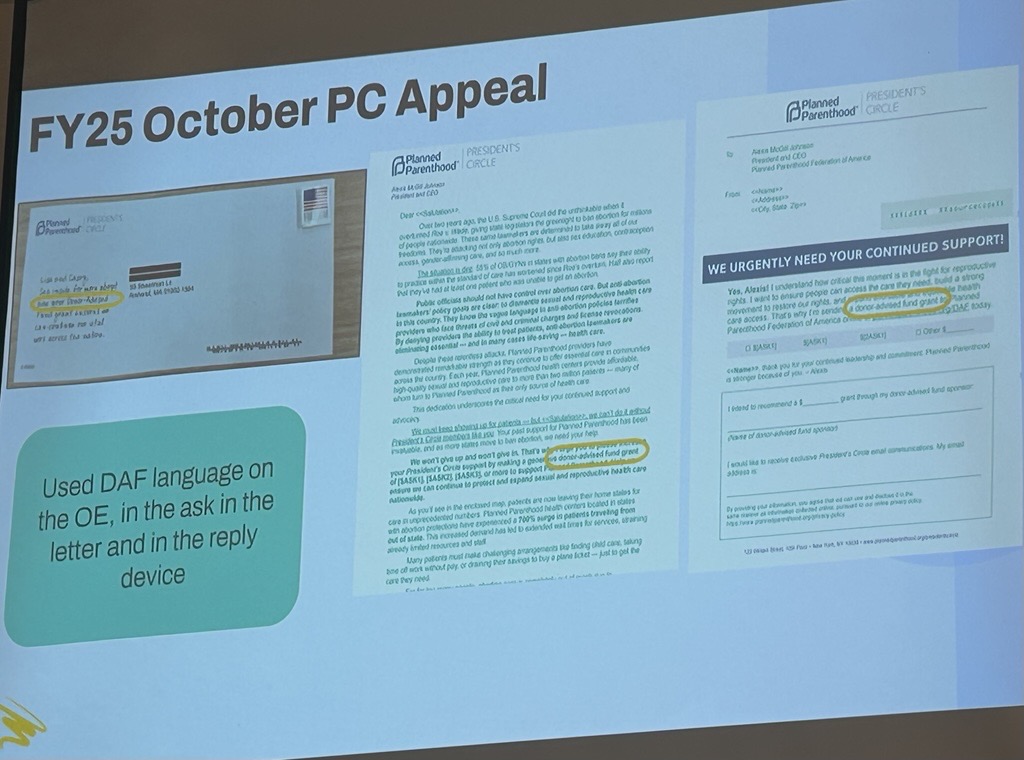
A slide showing the direct mail campaign Planned Parenthood sent to mid-level donors with donor-advised funds. Circled in yellow are the callouts about DAFs. Click to enlarge.
“What I love about it — all of this — is that it acknowledges the donor,” Kowsaluk said during the “Are You Engaging Your DAF Donors? Strategies for Leveraging DAFs for Mid-Level Growth” session on Thursday. “... This is a way of saying, ‘I know who you are, and I'm going to call it out from the jump.’”
So, what were the results of the direct mail campaign?
“DAF Day last year was on Oct. 10, so over a two-week period, we saw an increase in DAF grants by nine times year-over-year,” Felico said. “In 2023, we had $198,000 in [DAF] grants in that two-week period. The next year when we ran this campaign, we had $1.8 million in DAF revenue.”
Looking at fiscal year 2025 as a whole, DAFs generated $24,000 in revenue across 10,000 gifts for Planned Parenthood. The average gift size was $2,325.13. All said, 37% of Planned Parenthood’s 2025 mid-level revenue came from DAF grants.
Moving forward, Felico said she wants to collaborate on DAF messaging across Planned Parenthood’s development department — touching low-dollar donors, planned giving and more — as well as create a DAF portfolio for mid-level gift officers to do personal outreach and explore a matchback process.
Peer-to-Peer Donors
Peer-to-peer fundraising is another area with great potential for DAF giving — as it represents the biggest opportunity for DAFs, Elon Packin, head of partnerships at Chariot, said during the “DAFs and Peer-to-Peer: How the Largest P2P Fundraisers Are Finding Their Biggest Source of Growth With Donor Advised Funds” session on Friday.
DAFs have been largely untapped in most peer-to-peer spaces historically. Until recently, most peer-to-peer programs weren’t incorporating DAFs into communications, training or user experience, and accessing DAFs involved an excessive number of steps. In peer-to-peer specifically, DAF wasn’t a payment option embedded in peer-to-peer technology, and awareness of DAFs was low among both participants and staff.
However, DAF payments can now be incorporated directly into online forms, making the process intuitive and connected, building momentum and facilitating instant stewardship.

Elon Packin, head of partnerships at Chariot, talked about how the Alzheimer's Association is tapping into DAFs in the peer-to-peer program during the 20th annual Bridge conference. | Credit: NonProfit PRO
“The biggest opportunity for donor-advised funds is the area where people are least aware of it,” Packin said. “It makes sense, right? People have not been thinking about DAFs in the peer-to-peer space. And that's actually why there's such a big opportunity there — because there's so many new builders in the organization. There's so many instances where people are not using their DAF — even though they have one — in the peer-to-peer context, but that's where actually a lot of the underlying opportunity is.”
The Alzheimer's Association started to intentionally build DAF giving into its Walk to End Alzheimer’s, which features 600 individual peer-to-peer events with 350,000-plus participants raising more than $100 million every year. While the nonprofit has received DAFs in the past, they were given passively, and both internal staff and participants were confused as to what DAFs were. Plus, there was the added challenge of crediting DAF donations to specific participants.
“If you don't properly give [credit] back to that individual, the individual fundraiser and their friend — the person who donated — are both going to be very frustrated, and it makes your organization look very bad,” Packin said.
For the Alzheimer’s Association’s recent targeted approach, Wendy Vizek, senior vice president of community engagement and field operations, and Eric Oyler, director of digital fundraising, decided to revamp the DAF strategy by honing in on peer-to-peer. To do this, there were three pillars that made it work:
- Technology.
- Internal alignment with leadership buy-in and staff training.
- Participant education on DAFs.
Packin emphasized the importance of DAF education not only for participants, but for staff as well.
“Make sure people understand that, because they need to not just be able to nod ‘yes’ to you, but they need to be able to raise their hand and say, ‘I could explain it to somebody else,’” Packin said.
In the first 10 months since the Alzheimer’s Association incorporated Chariot’s DAFpay into its peer-to-peer forms in September 2024, the nonprofit raised $1.2 million in DAF grants across 1,858 gifts. This means the average DAFpay gift for the nonprofit lands at $647, an increase from the average peer-to-peer gift.
Beyond the numbers, everyone at the nonprofit has embraced the success DAFs have brought to the peer-to-peer program. Not only is leadership excited about the clear return on investment, the on-the-ground staff are excited as well. Some of Vizek’s peer-to-peer field staff have gone from being confused about DAFs to coming to her excited when their participants receive a DAF gift, she said.
This has even encouraged plenty of interdepartmental collaboration.
“[Vizek’s] mid-level giving team, her major giving team, her planned giving team — all super happy to be able to use peer-to-peer, not just for general donor acquisition, but for new DAF donor acquisition, and what that means for them, for their pipelines and the relationships that they're going to lean in on and then start to build,” Packin said.
Kalie VanDewater is associate content and online editor at NAPCO Media.