DAF Day 2025: Last-Minute Tips for Nonprofits to Capture Donor-Advised Fund Gifts

Donor-advised funds (DAFs) have quickly become a powerful engine of charitable giving. Approximately $250 billion is currently held in DAFs, with $55 billion granted to nonprofits in 2023, according to the “2024 Donor-Advised Fund Report” from the National Philanthropic Trust.
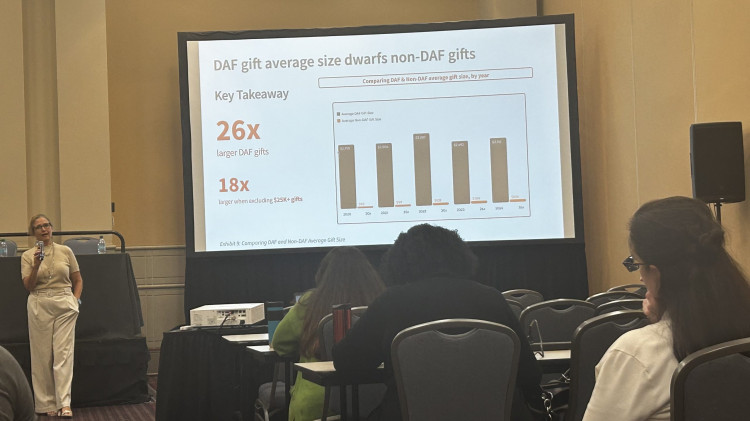
Mitch Stein, head of strategy for Chariot, and Karin Kirchoff, founder and president of K2D Strategies, discussed this data during their bbcon 2025 session, “Unpacking the ‘2025 DAF Fundraising Report’: A New Standard for DAF Gift Data,” held Monday in Philadelphia.
“Those figures are growing five and six [times], respectively, over a 10-year period,” Stein said. “... It’s not an exaggeration to say this is exploding, and it's just not slowing down, despite the scale it's already at.”
Nonprofits engaging these donors are seeing the results. Despite the well-documented decline in donors, DAF giving grew by 30% in 2024, making it the fastest-growing way to give, according to the “DAF Fundraising Report 2025” from Chariot and K2D Strategies.
“The revenue lost from shrinking donor pools has largely been offset by higher average gifts for many, many organizations,” Kirchoff said. “We're starting to see that not be the case anymore, and DAF revenue is starting to offset that for a lot of organizations.”
Though many nonprofits have been preparing for DAF Day for months, it’s not too late to join thousands of participating nonprofits if your organization hasn’t started.
Here are five data-driven ways nonprofits can still take advantage of DAF Day 2025 tomorrow and strengthen their year-end fundraising in the process.
1. Make It Easy for Donors to Give Via DAFs
The key to finding more DAF donors is removing friction associated with giving to your nonprofit in this way. Simplify the process by giving donors clear instructions and a direct DAF giving link.
When the ACLU wanted to make DAFs the first donation option on its “Ways to Give” webpage ahead of DAF Day, its web team noted donors were already clicking that option more than any other, Stein said.
Additionally, Jen Risher, founder of HalfMyDAF, which matches DAF gifts from those who grant half of their DAFs to nonprofits, confirmed the importance from a donor standpoint. Sheshared via video that if an organization doesn’t make it simple to give, she may only give $100 via credit card, whereas she may have given $1,000 via her DAF. This also lines up with the “DAF Fundraising Report 2025” findings.
“When someone switches to using their DAF to support the organization if they gave with a credit card before, the average change in their giving was 10x — funny that that lined up exactly [with] what Jen shared,” Stein said. “And even the median was two [times].”
2. Schedule at Least One DAF-Specific Email or Social Media Post
Though a series of emails or social posts educating donors about DAF Day leading up to Thursday may have been more ideal, try scheduling at least one email or social media post for Thursday. Then you can commit to planning a full campaign for the 2026 giving day.
This messaging can range from educating donors about DAFs to showing what their DAF gifts can accomplish. You can even ask them to make recurring DAF gifts, which most DAF grantors now support.
“That's really natural messaging that we can start to incorporate into our outbound asks for folks — ‘Make your sustaining gift $100 a month from your DAF,’ ‘$50 a month from your DAF,’ ‘$1,000 a month from your DAF,’ Kirchoff said. “And I think it's building that foundation, and then cultivating the messaging around it.”
While Vanguard Charitable’s $25,000 minimum to open an account attracts higher net worth donors, lower thresholds at Fidelity Charitable and DAFgiving360 make DAFs accessible to everyone — from annual donors to billionaires. Still, 69% of DAF gifts are under $1,000, per the “2025 DAF Fundraising Report,” showing gift size doesn’t equal wealth.
“It also means the donor who's making a $100 DAF gift — I can just about guarantee there's a lot more than $100 sitting in that account,” Kirchoff said.
3. Remind Donors Who Already Have DAFs
One of the biggest barriers to DAF giving is forgetfulness.
Nearly 38% of DAF owners didn’t use their DAF for their most recent gift, according to The Giving Compass’ “Donor Satisfaction and Unlocking Public Sector Funding from DAFs.”
“We're all human,” Stein said. “[Maybe] my financial adviser might have helped me set it up, or maybe your spouse uses it, and you can kind of forget about it. So these are just good donor feedback points to incorporate into your own strategies.”
You can also encourage donors to name your organization as their DAF’s beneficiary. Most granting organizations permit this but don’t require it, and some will assume the account at a person’s death if a person or org is not listed.
“It's a great thing to remind donors about again, just on an education basis, because they might not even know,” Stein said.
4. Thank DAF Donors Differently
If a DAF gift comes in this week, resist the instinct to send a tax receipt. DAF donors already received one when they funded their account — what they need is gratitude and recognition. On the other side of the exchange, there’s no need for nonprofits to thank the grant administrators.
“You should absolutely be acknowledging the donor — with an acknowledgement, not a tax receipt, because they already got their tax benefits,” Kirchoff said. “… You do not need to acknowledge the fund. Don't send Fidelity acknowledgements. They don't care if you're wasting the $0.75 or $1.25 — whatever it cost you to send that.”
Not only do DAF donors give more, but they retain better than non-DAF donors — 59% compared to 46%, respectively, according to the “2025 DAF Fundraising Report.” So, personalized acknowledgments and a special tag in your donor database can help your organization to properly steward these donors.
“So, these are also repeat donors, even though we're not necessarily doing a great job of going back out and asking them for another gift,” Kirchoff said.
5. Make DAF Day the Start of a Year-Round Habit
Even if your DAF outreach is simple this week, use it to build momentum for year-end. With 2026 tax changes on the horizon, incentives for high-income donors may shift. Kirchoff predicted a surge in DAF funding by Dec. 31.
“The new tax law that reduces the charitable giving incentive for very wealthy people starting in 2026 … is going to force a whole bunch of giving this year — and probably a lot of it's going to go into DAFs first, so I suspect we're going to see a huge funding of DAFs before the end of this year,” she said.
Make a few small moves before DAF Day to ensure your donors know your organization accepts DAF gifts — and build on that strategy for year-end and beyond.
“Last year, we definitely saw an increase in DAF data in October, and then we saw a corresponding increase through the end of the year,” Kirchoff said. “So it wasn't even just isolated to DAF Day.”